
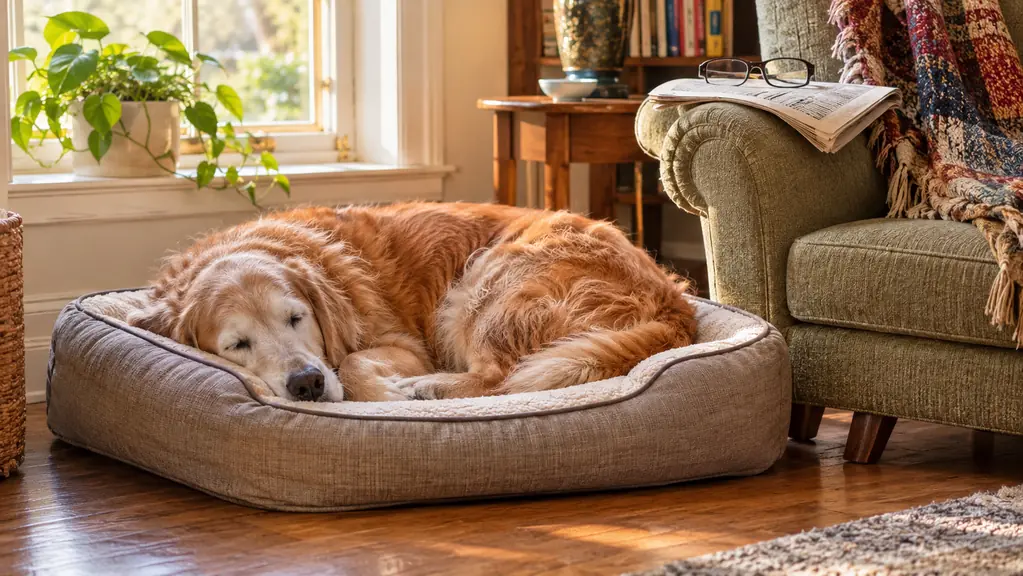
I bought the Bedsure orthopedic dog bed in January 2026 for a 58-pound Australian Shepherd mix named Juni, and I want to start with the thing the listing does not say out loud: the maximum weight recommendation printed in the product details is 15 pounds. I read that after the bed was already on my living room floor. Juni is nearly four times that. Ten months later the bed is still here, still her bed, and I still think anyone considering it deserves both halves of that story before they click.
Nobody sold me on this. I am 64, retired from the county library in Coeur d'Alene, Idaho, and I read every label twice because pet marketing has disappointed me more than once. My dog is not a puppy and she is not a project. She is twelve, she is slower than she used to be, and this bed replaced a thin flat pillow bed that had gone flat in the middle. That is the whole setup, and it is why I am going to be blunt about the parts that did not work.
The Quick Verdict
A genuinely comfortable bed for a medium-sized older dog, undermined by a weight field that contradicts its own large-size label.
Amazon Check Today's Price →Ten Months In, This Is Still the Bed She Sleeps On Every Night
Read the dimensions before you read the word large. If your dog measures right against 38 by 28 inches, this is a fair bed that holds up to a real dog and a real wash cycle.
Amazon Check Today's Price on Amazon →What the Listing Claims and What Actually Arrived
The listing calls it an orthopedic sofa with a four-sided bolster and egg-crate polyurethane foam. What arrived was a rectangular bed, 38 by 28 by 6.5 inches, with a bolster running along all four sides and a cover that zips off. The foam underneath is egg-crate, the bumpy profile, not a smooth slab. The whole thing weighs 6.77 pounds per the product details, light enough that I can drag it from the living room to my bedroom by one corner when I want her near me at night.
It came compressed and rolled, and I will admit I stood in the kitchen for a minute wondering if I had ordered the wrong thing. The foam needed a day to come up to its shape. I unrolled it on the living room floor on a Thursday, and by Friday evening it looked like the picture. If you open the box and it seems thin, give it overnight before you decide anything.
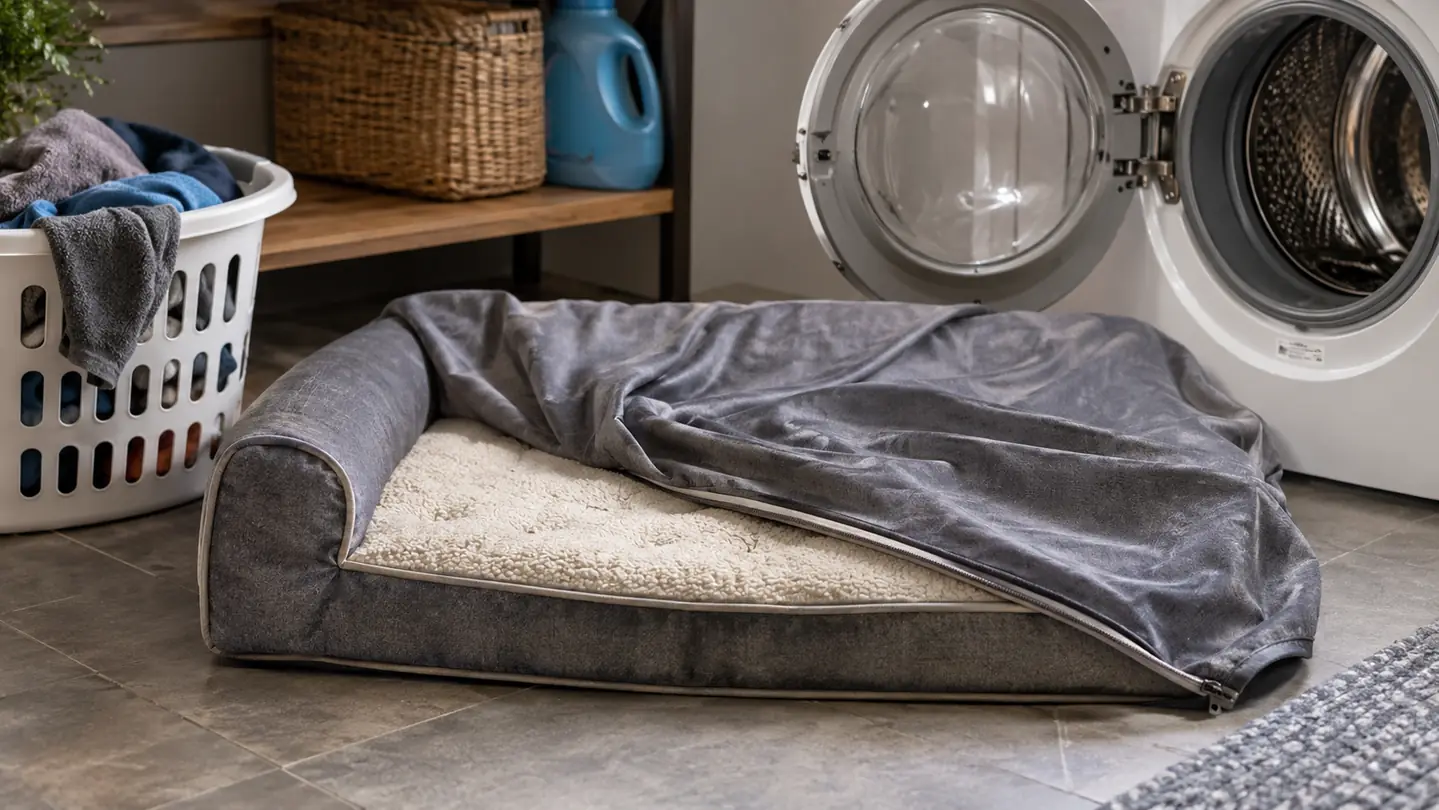
The cover is removable and washable, and the listing describes the bed as waterproof. I have not tested that by pouring water on it, so I will only tell you what I know. Juni has had two accidents on it in ten months, both in the first weeks when the weather turned and she did not want to go out. Both times the cover came off, went in the wash, and the foam did not smell afterward. The materials are listed as standard 100 by OEKO-TEX and the foam as CertiPUR-US certified. I am not a chemist. I mention it because I read labels twice, and those are the two certifications on the tag.
One detail from the listing I want to repeat in plain words, because it is buried: the maximum weight recommendation is 15 pounds. The breed recommendation field says large. The dimensions say large. The weight field says 15 pounds. I do not know which one is the mistake. I know Juni is 58 pounds and sleeps on it every night, and I know anyone with a genuinely big dog, a Lab or a shepherd closer to 90, should study the dimensions and think hard before ordering.
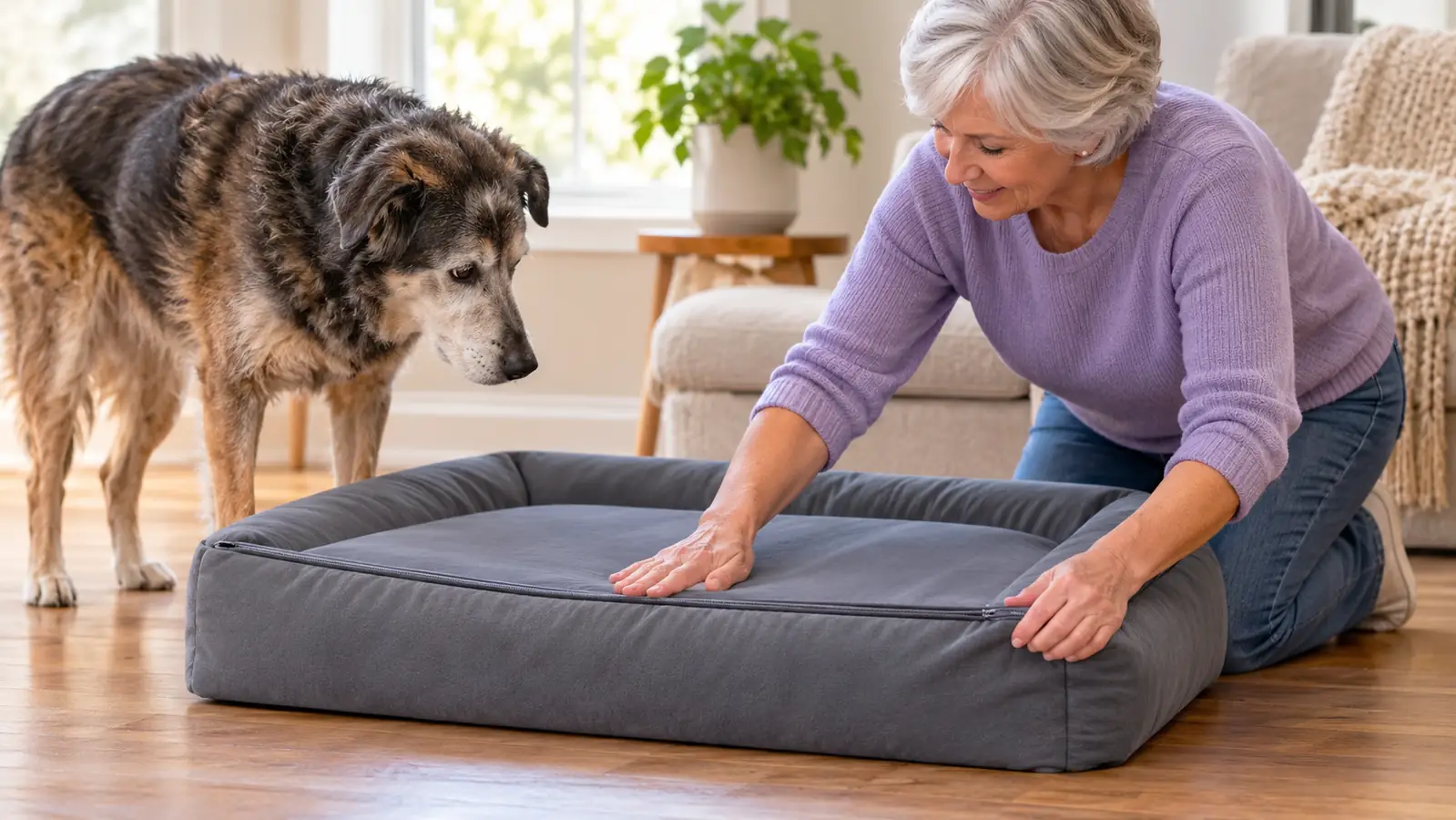
How I Have Actually Used It: Ten Months, One Dog, Every Night
The bed went down on the living room floor in January 2026, beside my reading chair, and it has not moved since. Juni circled it twice the first night, lay down on the floor next to it instead, and got on it by the second night. That is her pattern with anything new. She sleeps there all night, roughly nine thirty to six thirty, and she gets up off it in the morning the same way she gets up off anything these days, slowly, back end first.
The first week I tried to improve on it, which is my habit. I folded a fleece blanket and laid it over the foam, thinking she would want something softer against her hips. She stepped around it, sniffed it once, and slept on the bare cover instead. I gave up and left the bed alone after that. I also put it beside my reading chair rather than in the bedroom, mostly by accident, and that turned out to be the right call. She wants to be where I am in the evening. The bedroom is carpeted and warmer, and she still walks past that room at nine thirty to get to the living room.
What I can tell you honestly is that she chose it. The old pillow bed is still in the house, folded in the closet, and she has never once asked for it. In the cold months she sleeps with her chin propped on one of the bolsters. In summer she stretches out flat in the middle. She is a dog who has always wanted something under her hips, and this gives her several inches of foam to settle into instead of the inch and a half she had before. Whether that is why she seems a little easier in the mornings, I cannot prove, and I am not going to pretend I can.
I will say the obvious thing that reviews tend to skip: a bed is not a treatment. It does not loosen a stiff joint or rebuild anything. It is a place to sleep, and the only questions worth asking are whether your dog sleeps well on it and whether getting up is any harder than it was. For Juni, the answer is yes to the first and no to the second. She sleeps well. She still gets up stiff on cold mornings, and the bed was never going to change that. If your dog is on medication or has a diagnosis, talk with your veterinarian before you change anything in their routine, including where they sleep.
She sleeps well on it. She still gets up stiff on cold mornings, and no bed was ever going to change that.
The Size Question, Said Plainly
I keep coming back to the 15 pounds because it is the most confusing thing about this bed. If you trust that number, a 58-pound dog should not be anywhere near it. If you trust the dimensions, 38 by 28 inches is a large bed and Juni fits with room to spare, though not dramatically. She lies curled with her chin on the bolster and her back end centered. A dog ten pounds heavier would be hanging off one end. A dog twenty pounds heavier would be on the floor.
I measured her once with a tape on the living room floor while she was dozing, which is easier than it sounds because she barely moved. Nose to the base of the tail she was 34 inches stretched out. Curled, which is how she actually sleeps, the footprint was closer to 26 inches across and about 20 front to back. Against 38 by 28 that leaves room, but not acres of it. The old pillow bed was 30 by 20, and when I set the two of them nose to nose on the floor the difference was smaller than I expected, mostly thickness rather than width.
So my advice, and I mean this for any bed and not just this one, is to measure your dog while they are lying down, nose to the base of the tail, and add a few inches. Then hold that number against 38 by 28. Do not trust the word large on any listing. Large means something different to every manufacturer, and here it means something different than the weight field suggests, which is exactly the kind of thing that makes me read a label twice.
The other dimension worth knowing is the 6.5 inches of thickness. That is the height of the whole bed, bolsters included. The sleeping surface in the middle is lower, maybe four inches of foam under the hips. For an older dog who has to step onto it, low is good. For a heavy dog, low is less forgiving over time, which brings me to the dip.
The Dip, and What Ten Months of a 58-Pound Dog Did to the Foam
There is a dip now, right where her hips go. It showed up somewhere around month seven or eight. It is not a crater and she has not stopped using the bed, but if I press my palm down in the center it sinks noticeably more than it does at the edges. Egg-crate foam does that. It is built with a bumpy profile to spread weight, and it compresses where the weight stays put night after night.
The first thing I did when I noticed it was take the cover off and turn the foam over, then zip it back up. The cover comes off easily enough that this took me about five minutes on a Sunday. It bought a few weeks of feeling like a new bed, and then the dip came back in the same place, which told me what I already suspected. I also tried shooing her off it in the afternoons when I caught her napping there. That lasted four days. She came right back, and I decided a dog should be allowed to nap where she is comfortable.
Is that a defect? I do not think so, not at ten months and not for a bed of this kind. I think it is what foam does. But if you are expecting something that holds its shape like a mattress for five years, this is not that bed, and I do not think any bed in this category is. My guess is I get another year out of it before the dip bothers her more than it bothers me, and I will know it is time when I see her start sleeping on the floor again.
The cover has held up better than the foam. Ten months, washed roughly every two weeks, so about twenty washes. The zipper still runs, the seams are intact, and it has not pilled badly. The only wear is some slight softening at the top edge of the bolster where her chin rests, which is precisely where I would expect to see it. I wash it on a Sunday, air dry it on the porch rail, and it goes back on the same afternoon.
What I Liked
- Juni got on it by the second night and has slept there every night since
- The removable cover washes clean; two accidents left no smell in the foam
- Several inches of egg-crate foam give an older dog something to settle into
- Bolsters on all four sides give her a place to rest her chin
- At 6.77 pounds it is light enough for me to drag room to room by one corner
- The zipper and seams survived about twenty washes in ten months
Where It Falls Short
- The listing's maximum weight recommendation is 15 pounds, which fights the large-size label
- The foam developed a visible dip under her hips by month eight
- 6.5 inches is the full height of the bed, not the sleeping surface
- There is no way to tell from the listing which size number to trust
- A dog well over 60 pounds will be hanging off the edges
What It Has Not Done
I want to be clear about the limits, because I have read too many reviews that made a bed sound like a turning point. The Bedsure bed has not made Juni younger. She is still stiff on cold mornings. She is still slow on the two concrete steps out to the yard, still uses her support harness for those steps, and still needs the ramp to get into the Outback. The bed did not replace any of that. It sits underneath all of it, literally, a place where she is comfortable for nine hours at a stretch.
Cold mornings are the real test here. Idaho gives us plenty of them. On a morning in the low twenties she comes off that bed, walks the length of the kitchen, and her back end is stiff for the first few steps the way it has been since the fall before last. I have paid attention on the warmer mornings and she is easier on those, which tells me it is the weather and not the foam. What I would say is that a bed shows you quickly whether your dog will use it. If Juni had refused it the first week, I would have sent it back and not thought twice about it.
And I cannot tell you what did what. I started the glucosamine chews on Dr. Lindqvist's advice a few months before the bed. The socks came before that and the harness came after. Five things, added one at a time, and no honest way to separate them. What I can say is that the bed is the thing she spends the most hours of her day on, and it is the one I would replace first if it wore out.
What About the Memory Foam Beds People Ask Me About
People ask about the JOYELF memory foam bed and I have to be straight with you: I have never owned one. I have read the listing and compared the descriptions, and that is the whole of my experience with it. The JOYELF is described as memory foam, which is a different material from the egg-crate foam in the Bedsure bed. Memory foam is meant to hold a shape. Egg-crate foam spreads weight through the bumps. Which suits your dog is a question for you and your veterinarian, not for me, and I would not guess at it.
Stairs are a different job entirely. If your dog will not use a ramp and the jump into the car is the real problem, that is worth a conversation with your vet rather than an opinion from me. I went with a folding ramp because that is what suited Juni and my Outback. Every dog is different and I would not argue with anyone who chose otherwise.
Who This Is For
This bed makes sense for a medium-sized older dog, somewhere in the 40 to 60 pound range, who wants to settle into something soft and rest their chin on a bolster. It makes sense if you are willing to read the dimensions and quietly ignore the weight field. It makes sense if you can wash a cover every couple of weeks without resenting it, and if you accept that foam compresses over a year. Mostly it makes sense if your dog is currently sleeping on a thin flat bed that has gone flat, which is exactly the situation I was in last January.
Who Should Skip It
Skip it if your dog is over 70 pounds, and skip it without guilt. The foam is not built for that, and the listing's own weight field agrees with me. Skip it if your dog is a chewer who goes through covers, because a zippered cover is still a zippered cover. Skip it if you need something that holds its shape for years, or if your dog likes to stretch out flat and would find the four bolsters claustrophobic. And skip it if you are hoping a bed will fix something, because it will not. I would rather tell you that now than have you find out in March.
If Your Dog Measures Right Against 38 by 28, This Bed Earns Its Place
Ten months, about twenty washes, one dip in the foam, and a dog who still chooses it every night. Read the dimensions first and the word large second.
Amazon Check Today's Price on Amazon →