
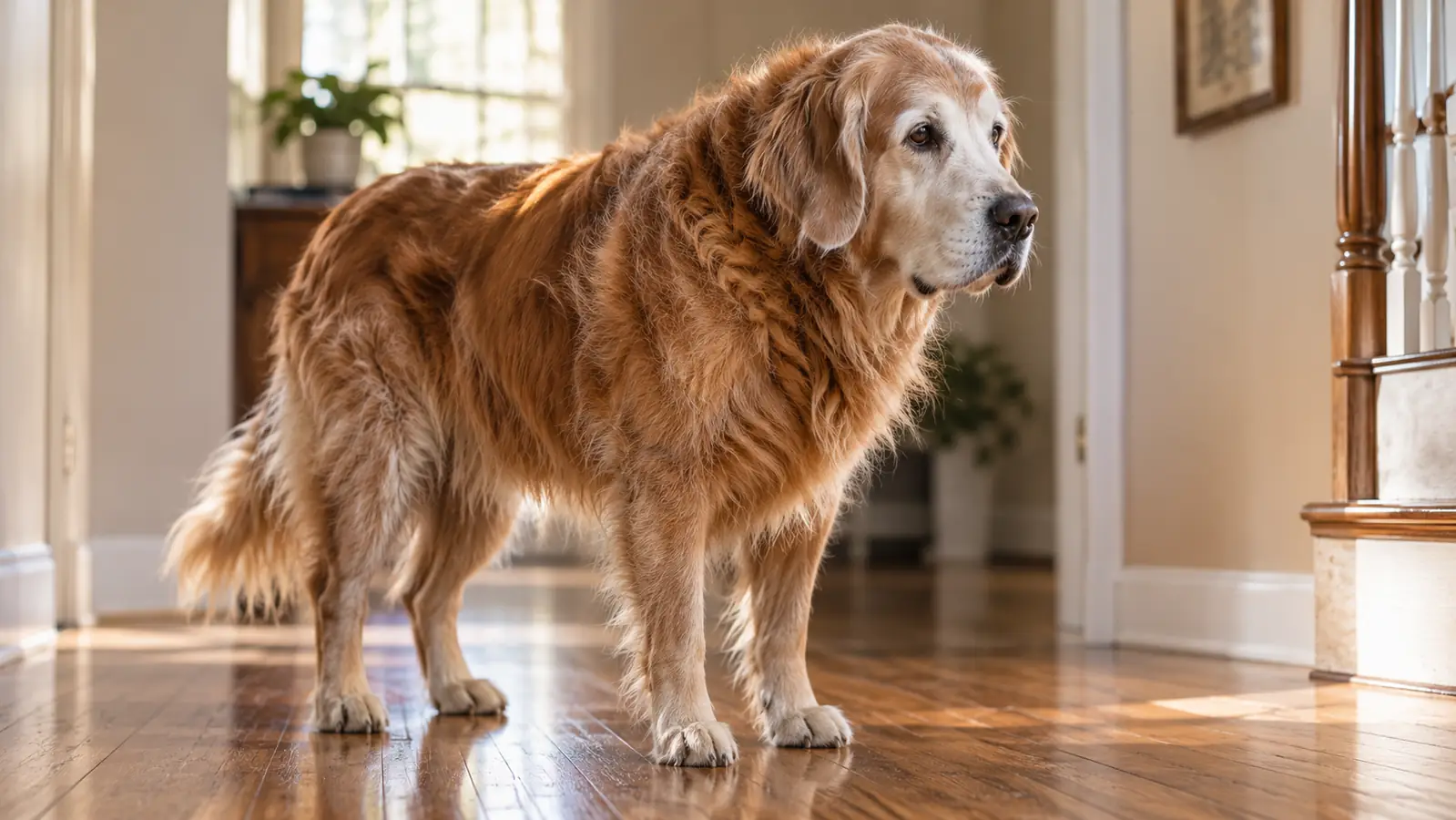
The morning my Juni's back legs went out from under her on the kitchen floor, she did not yelp. She just sat down hard and looked at me like I had moved the floor on purpose. She was eleven then, an Australian Shepherd mix, fifty-eight pounds, and she had crossed that same stretch of laminate ten thousand times without a thought. That week she also stopped at the back of my Outback and would not jump in. Two things, same week, and both of them about traction and back-end strength.
I am not a vet, a vet tech or a trainer. I am a retired library clerk who reads labels twice and does not believe most of what a listing tells me. What I can tell you is what I did, in the order I did it, and what I actually saw in my own dog. The short version: a call to my vet, a walk around the house with a notepad, and a set of DOK TigerToes grip socks that Juni has worn on the laminate every day since November 2025. If you are watching your older dog skate across a wood floor and you are not sure where to start, this is the order that worked in my house. Call your veterinarian first. That is step one for a reason, and it is not a formality.
The socks that ended the kitchen-floor slide in my house
DOK TigerToes are what Juni has worn on the laminate since November 2025, every day from breakfast to bedtime. Four socks in the set, hook and loop closure, machine washable, sized by paw width. Large fits paws 2.5 to 2.8 inches wide per the listing, so measure before you order.
Amazon Check Today's Price on Amazon →Step 1: Call Your Vet Before You Buy Anything
I called Dr. Lindqvist the day after the kitchen floor and he saw Juni that same week. I wanted to know two things: whether the sliding was just age, and whether there was something going on that I should be treating instead of cushioning. That is a question only a vet can answer about your dog, and it is not one you want to answer yourself with a search engine at eleven at night.
What I got out of that visit was not a diagnosis to hang on the wall. It was permission. He told me a slippery floor is a real problem for an older dog and asked me what the floors in my house were made of, whether there were steps, and how she was getting in and out of the car. He also asked what she was eating and whether she was on anything. I answered honestly and I asked before I changed anything. That is the part I would underline if I were handing you this page in person: talk with your own vet before you start a supplement or change a routine, particularly if your dog is on medication or has a diagnosed condition.
I want to be clear about what that visit did not do. It did not fix her. She is twelve now, she turned twelve in April, and she is still an old dog who is slower than she used to be. Nothing I have done since has changed that and I would be lying to you if I said otherwise. What I was after was smaller and more realistic: fewer slips, less scrambling, a dog who could walk across her own kitchen without that panicked little scrabble of claws on wood.
Step 2: Find the Actual Slippery Spots, Not All of Them
My whole house is not the problem. I have laminate wood in the kitchen, the hallway and the living room. Carpet only in my bedroom. Two concrete steps from the back porch down to the fenced yard, and no stairs inside at all, one story, which I am grateful for now in a way I never thought about when I bought it.
So I walked the house the way she walks it. Kitchen first, because that is where the slide happened and where she turns tight corners waiting for me to put a bowl down. Then the hallway, which is a straight shot with nothing to catch a paw. The living room rug near my reading chair turned out to be fine. Her bed sits beside that chair and she steps onto it, not across the floor, so that stretch never showed me anything.
Write down what you see. Not what you assume. My list was three rooms and two concrete steps, and the two concrete steps turned out to be a grip problem and a strength problem at the same time. That distinction matters, because a sock does not fix a strength problem and I will get to that.
One more thing I noticed in that walk-through. She was worse in the morning. Cold, stiff, first hour of the day, and Idaho winters are long enough that it is most of the year. If your dog is worse on cold mornings, that is worth mentioning to your vet too.
Step 3: Get the Socks and Measure the Paw, Not the Dog
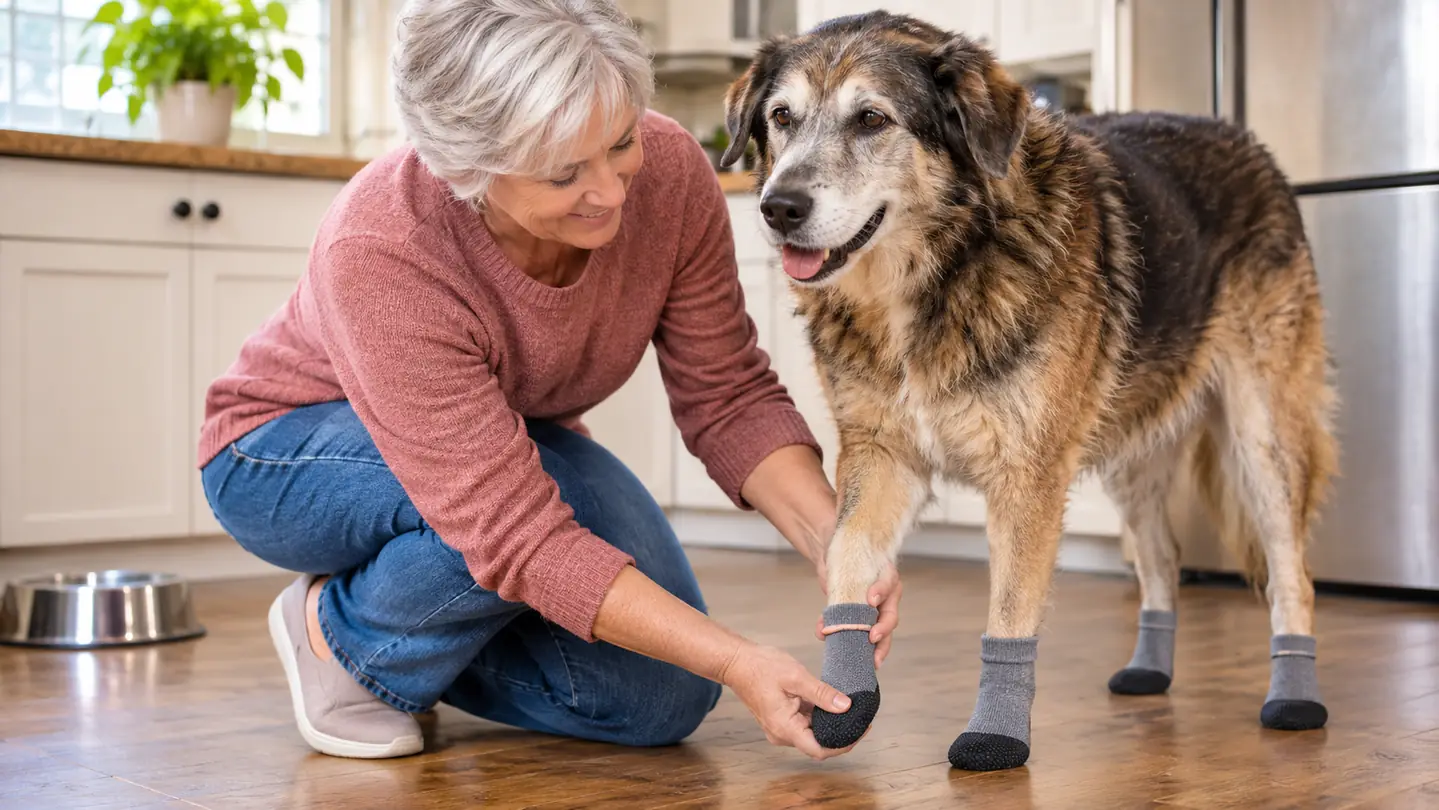
I bought the DOK TigerToes socks in November 2025, after the vet visit and after I had walked the house. What sold me was that they are sized by paw width, not by dog weight. The listing for the large says paws 2.5 to 2.8 inches wide, and the set comes with four socks. Cotton and nylon, machine washable, hook and loop closure, and grip built into the sock. They are meant for exactly this: hardwood floors, older dogs, indoor traction.
Measure the paw. Get a soft tape or a ruler and measure across the widest part of the foot while your dog is standing, because a standing paw spreads. I measured Juni's front paw three times over two days because I did not trust one reading, and I wrote the number down. If you are between sizes, that is a question for the listing and the seller, not for me.
The first morning was not graceful. Juni lifted her feet high around the kitchen for about ten minutes, that exaggerated high-stepping walk dogs do when something is on their feet, and I stood there feeling like a fool. I left them on. By the third day she ignored them. She has worn them every day since, on from breakfast to bedtime, off overnight, and I have not once had to bribe her.
What I can tell you after twelve months is narrow and I want to keep it narrow. Her back legs have not slid out on the kitchen floor the way they did in September 2025. That is what I have seen. It is not a promise about your dog, and it is not a treatment for anything. It is a sock with grip on the bottom, and on my floor, with my dog, the scrambling stopped.
Her back legs have not slid out on the kitchen floor the way they did in September 2025. That is what I have seen. It is not a promise about your dog.
Step 4: Build a Routine You Will Actually Keep
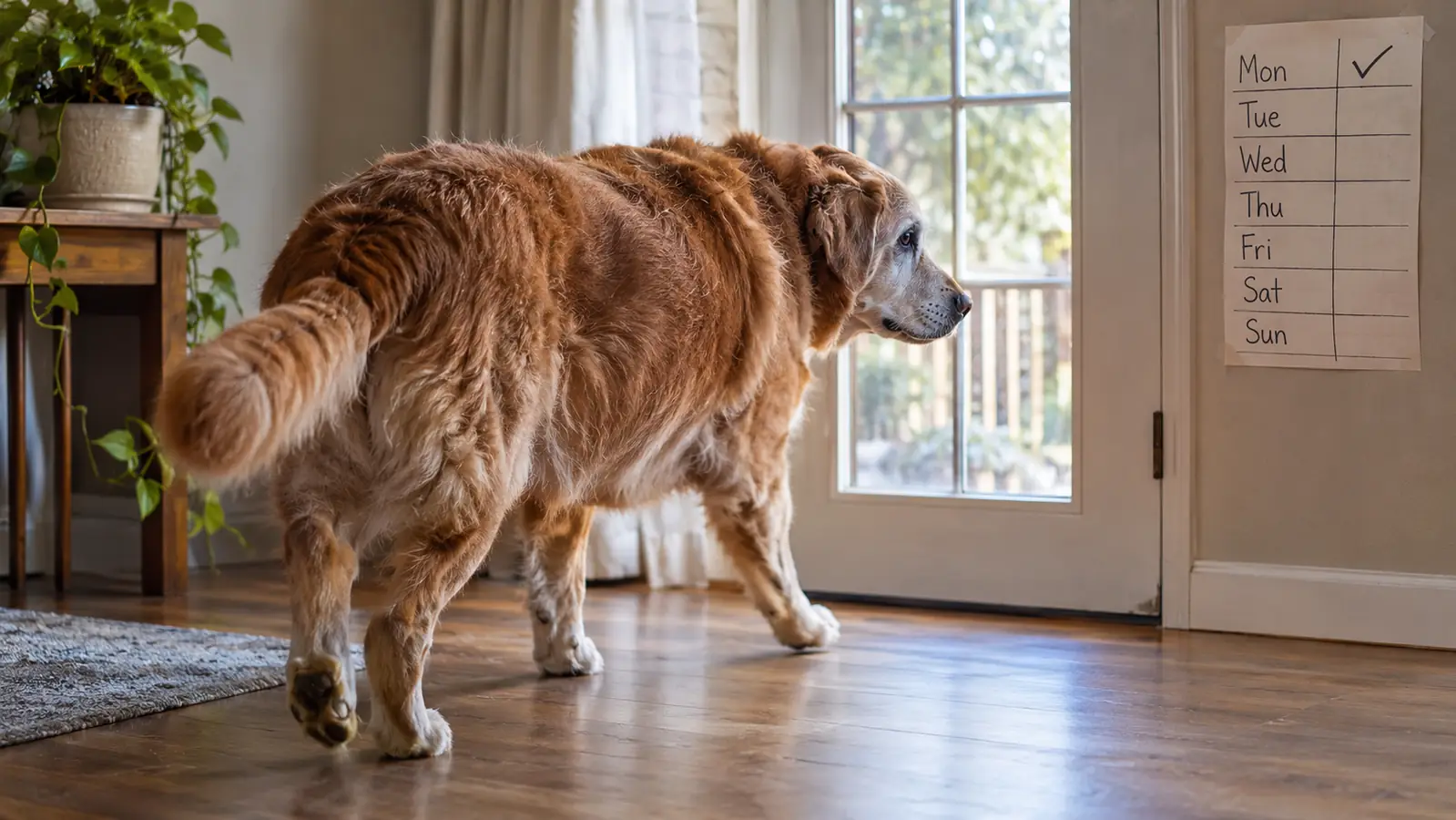
A product only works if the routine around it holds up. Mine is this. Socks on right after she gets up, around six thirty. Breakfast, with her Cosequin crumbled over the kibble at the amount on the label for her weight, and I asked Dr. Lindqvist before I started that too. Harness on for the two back steps before the morning walk, because those steps are a strength problem and the socks stay inside. Socks off at bedtime, around nine thirty.
The evening check is the part I would not skip. When the socks come off I look at all four paws. Not a production, thirty seconds, but it is how I caught that the back two socks twist. They rotate on her back feet during the day and sometimes slip off by the afternoon, and I have to re-seat them, pulling them back around and snugging the strap. The front two stay put. If your dog is a bigger kicker than mine, expect to check more than once.
I wash the socks on Sundays. One load, machine wash, and they have held up through a year of that. I have four in rotation and no backups, so if you are the type to lose one under the couch, order a second set earlier than I did.
I also keep a small notebook. Not a chart on the wall, just a line or two, whether she scrambled on the kitchen floor that day, whether she hesitated at the steps. It is the only way I can tell you honestly what changed, because memory flatters. A dog has a good week and you decide the socks are working. A dog has a bad week and you decide they never did. The notebook settles it.
Step 5: Deal With the Steps and the Car Separately
Here is the honest limit of grip socks. They help on the flat, hard floor. They do nothing for the two concrete steps down to the yard, and they do nothing for the back of a car. Those are different jobs and I learned that the hard way over several months.
For the steps I used a rolled bath towel under her belly as a sling for about two weeks, until the PICK FOR LIFE lift harness arrived in March 2026. It is a padded rear support band that goes under the belly and hips with two handles, not a full-body harness, and it hangs on a hook by my back door. I take some of her weight while she does the walking. It slides back toward her hips if I do not get the drawstring snug, and it does nothing for her front end, but it made those two steps survivable for both of us.
For the car it was worse. From September 2025 to May 2026 Juni rode only to the vet, and my neighbor Hal had to help lift her into the Outback, which is the only time anyone lifted her and which I cannot do at fifty-eight pounds. Then in May 2026 I got the PetSafe Happy Ride folding ramp. It took about two weeks of practice, first flat on the driveway, then up on the hatch, a bite of string cheese at a time, before she walked it on her own. She uses it about twice a week now, the Sunday lake trip and errands. It is ten pounds and awkward for me to swing out of the cargo area, and it feels steep at the hatch, so I wipe it dry before she uses it if it has been wet.
You may not need all of this. You may only need the socks. But if your dog is slipping on the floor and hesitating at the stairs and refusing the car, know that those are three problems, and the socks are the answer to one of them. That is not a knock on the socks. It is just the truth about what they are.
What Else Helps
Two smaller things made a difference in my house and neither one costs anything. The first is a path. I put a runner rug down the hallway where she has nothing to catch a paw, and I keep the floor clear of the clutter that used to pile up near the door. A clear floor is a safer floor. The second is trimming the fur between her paw pads. The groomer does it and I asked her to keep it short, because fur growing out between the pads is one more thing between the paw and the floor.
I also stopped rushing her. That sounds like nothing and it changed everything about our mornings. She gets to the back steps when she gets to them. The walk is twenty minutes and sometimes it is twenty-five. The dogs I have had all wanted to keep going and I was the one putting a clock on it.
And I kept going back to the vet. Not every month, but when something changed. When she started hesitating at the back steps more in January, I had her looked at again rather than guessing. I am not qualified to tell you what is going on inside your dog's joints, and neither is anyone selling a product, including the people who made the ones I use. A recheck is a boring answer and it is the right one.
The other thing I did, in January 2026, was replace her thin flat pillow bed with a Bedsure orthopedic bed, and I am honest that I cannot untangle which product did what. The socks, the bed, the harness and the Cosequin all started at different times, and I cannot prove what helped and what did not. If you take one thing from this page, take that: nobody can promise you a result for your dog, least of all me. Ask your vet, change one thing at a time, and write down what you see.
Start with the floor, because that is the slip you can see
The DOK TigerToes four-pack is the simplest, fastest thing on my list to try, and it is the one that ended the kitchen-floor scramble in my house. Measure your dog's paw width at the widest part while standing, check it against the listing, and talk with your vet about the rest.
Amazon See the DOK TigerToes Socks on Amazon →