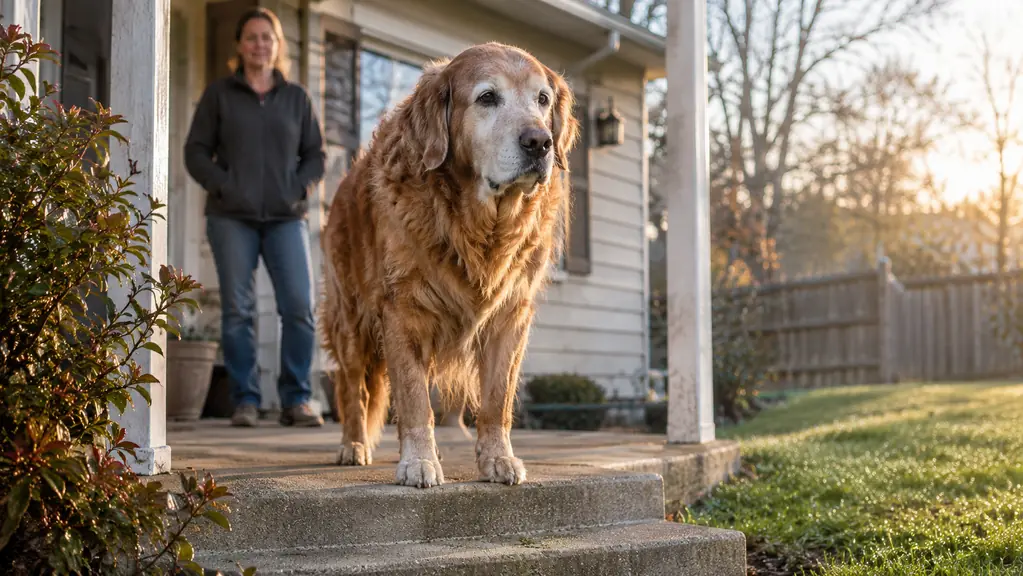
Juni is twelve. Australian Shepherd mix, fifty-eight pounds, adopted from the Kootenai County shelter in 2016 when she was two years old. For most of a decade she went down the two concrete steps off my back porch at a trot, four or five times a day, and I never once thought about those steps. Then one morning last September she stopped at the top of them and looked at me instead of going down. I was in my robe with a cup of coffee going cold in my hand. That was the morning the steps stopped being a habit and turned into a decision, and it is the reason I own a lift harness.
Here is what I did first, and I suspect it is what most of us do. I rolled a bath towel into a sling and held it under her back end for about two weeks. It worked, mostly. It also dug into my fingers, slipped whenever she shifted her weight, and left me bent at an angle my lower back complained about all afternoon. In March I bought the PICK FOR LIFE Dog Lift Harness. It is the towel's idea with a padded handle sewn on, and that handle is the whole difference when you do it twice a day for eight months.
The handle I reach for before my coffee
A padded rear sling with two handles and an adjustable strap, made for large and extra large dogs. It hangs on a hook by my back door and takes about thirty seconds to put on. Read the sizing details before you order.
Amazon Check Today's Price on Amazon →Before Anything Else, Call Your Vet
I am not a veterinarian, a vet tech or a trainer, and nothing in this article is medical advice. Juni is my dog and I am telling you what I did in my own house. Before I changed anything about how she gets around, I asked Dr. Lindqvist at our regular clinic whether a rear support sling was a reasonable idea for her, and I described how much weight I intended to take. If your dog has been diagnosed with anything, takes medication, or has changed how she walks, that conversation comes before a purchase. It costs you a phone call.
The way I think about it now, after eight months of practice: a sling assists, it does not carry. If your dog cannot bear weight at all, that is a different conversation and possibly a different piece of equipment, and it is one for your vet rather than for a stranger's article. What I can tell you is the narrow case I know, which is an old dog who can still walk and who had started to hesitate at two steps.
Step 1: Size the Harness Before You Order It
The PICK FOR LIFE harness comes in sizes, and the X-Large is what I bought for a fifty-eight pound dog with a deep chest. The listing gives an adjustable strap length of 52 to 76 inches and recommends the harness for large to extra large dogs. That range is wide, which is convenient and also a good reason to measure instead of guessing from a photo.
Measure around your dog's hindquarters at the widest point. Then think about where the band will actually sit and how much strap you want between your hand and her hips. Write both numbers down. If your dog lands between sizes, take the larger one and set the drawstring snug, because a sling that runs short rides up into the belly every time she steps down and you will fight it all morning.
I ordered the X-Large because Juni sits at the front edge of it, and I have not needed to exchange it. That is one dog and one order. It is not a rule for yours. Your dog's shape is not Juni's shape, and a harness that fits her is not evidence of anything about a dog with a longer back or a narrower chest.
Step 2: Let Your Dog Meet It While Nothing Is Happening
The harness arrived folded in a small box, all fourteen ounces of it, nylon with the padded handles and a drawstring closure. I did not put it on her the first day. I set it on the kitchen floor where she could sniff it, then on the arm of the sofa while I read, then across my knees while I watched television, until it stopped being an object that had appeared in the house and became an object that was simply around.
This sounds fussy and it is not. Juni notices anything new and plants her feet about it. By the third day she ignored the thing entirely, which is the best result I know how to get from a dog who is set in her ways.
The first time I put it on her, she stood still and let me do it. No drama, no backing away, no look over her shoulder. I have since decided those two days of nothing happening are the reason why, and I would spend them again.
Step 3: Place the Band and Set the Drawstring
The PICK FOR LIFE harness is a band, not a full-body harness. There is no front chest piece. It goes under the belly and hips, the strap runs up to the handles, and it closes with a drawstring. Set that drawstring snug. Tied loosely, the band slides backward toward the tail the first time your dog steps down, and then you are standing in a doorway in the cold tugging at nylon with one hand while your dog waits and wonders what you are doing.
Where you stop the band matters more than I expected. Too far forward and you are lifting the middle of the dog, which does nothing for the back legs. Too far back and it will not stay put. I set it just in front of her hips, check it with two fingers, and go.
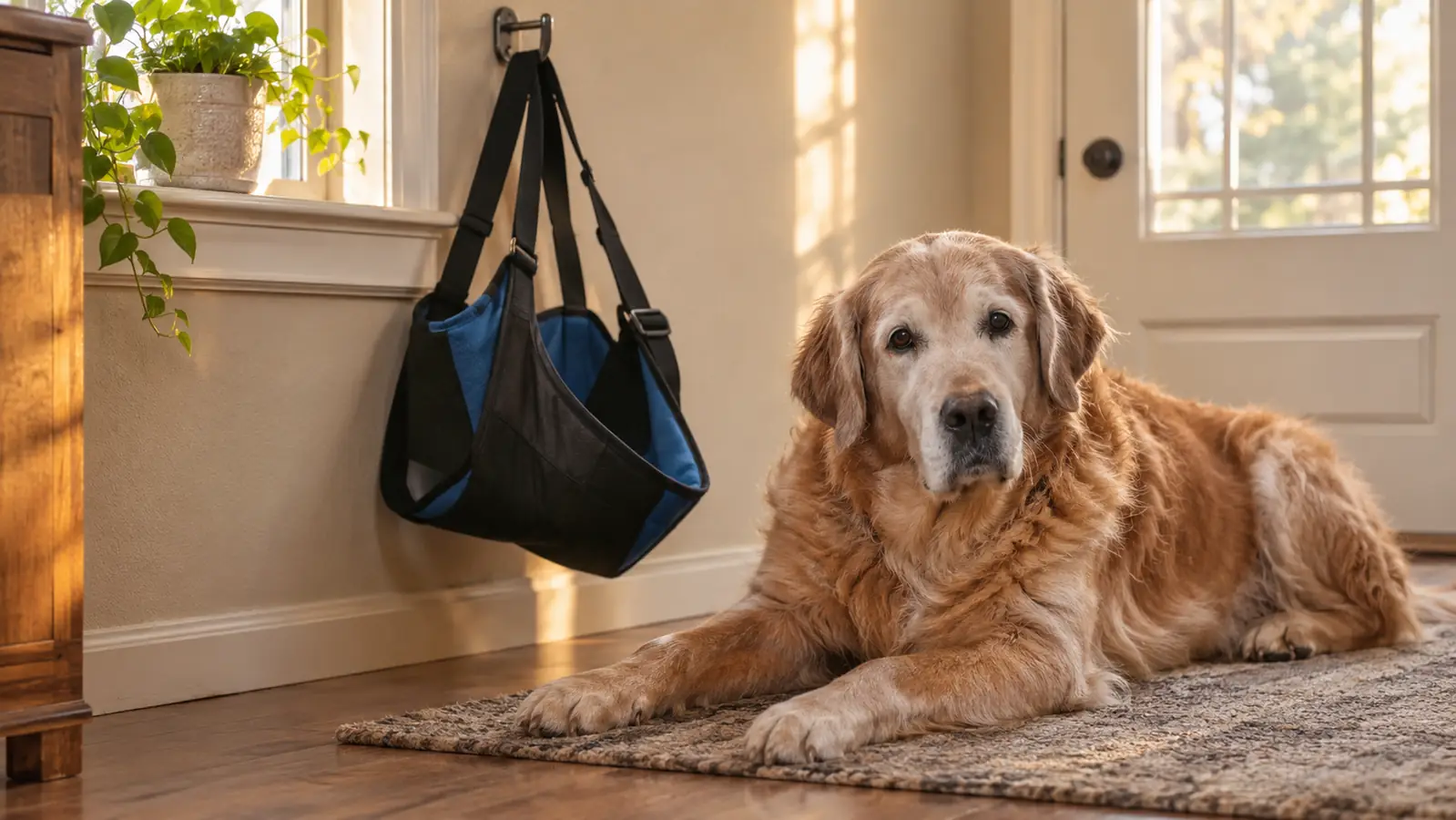
It comes off in about five seconds and it is machine washable. I rinse it in the sink every couple of weeks and hang it back on the same hook by the back door. Hanging it in the same spot every single time is the only reason I remember to put it on, and the only reason the routine survived past the first month.
Step 4: Take Some Weight, Not the Whole Dog
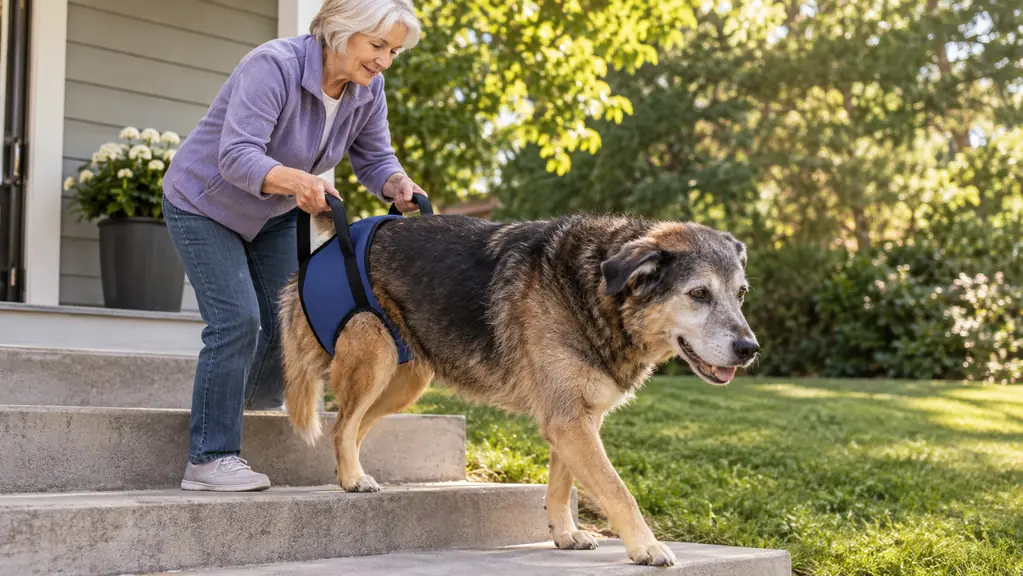
This is the part I got wrong for the first week. My instinct was to hold the handle high and lift, and that made Juni stiffen and stop moving, because she does not want to be carried and she will tell you so. What works is taking part of her weight and letting her walk the step herself. My hand takes load through the padded handle, the strap stays under her hips, and her back feet do the stepping.
The two handles help here. I use the nearer one going down and the far one coming up, and the padding is the difference between doing this comfortably and doing it through my fingers like the towel. It is a small thing that turns into a large thing on the four hundredth repetition.
You will be bending. There is no way around that at fifty-eight pounds, and I say so plainly because someone should have said it to me before I bought the thing. I brace my left hand on the porch rail, which takes the twist out of my back. If bending is hard for you, that is worth knowing before you order, not after.
Step 5: Do It Every Time, Twice a Day, Which Is the Boring Part
The harness hangs by the back door and it goes under Juni every morning when we go down to the yard, and every evening when we come back up. Not only on the mornings she looks stiff. The mornings she looks fine are the ones where I am most tempted to skip it, and those are exactly the mornings I have regretted skipping. Two steps is not the point. The point is that she gets to keep doing them.
Eight months in, the routine is: harness on, down the steps, off at the grass, walk, back up, harness off, hang it on the hook. Thirty seconds, end to end. I leave the strap set where it was so I am not adjusting it in the cold with a dog waiting on me. The PICK FOR LIFE harness is the only piece of equipment in this house that gets used every single day without me having to think about it, and that is most of why it earned its hook.
Bad days run differently. On the days Juni is stiff I use the harness at the back of the Outback as well, steadying her while she walks up the ramp instead of being lifted. At fifty-eight pounds I cannot lift her into that car, and I stopped pretending I could somewhere around last winter. If you cannot lift your dog either, say it out loud and build the routine around that fact instead of around a better day you are hoping for.
One more thing about the routine, because it took me a while. I keep the harness where I can reach it from the door with one hand, and I put it on before I put my own coat on. If the order reverses, I get cold, I hurry, and I skip it. Small logistics, but that is what decides whether a piece of equipment gets used or hangs there looking useful.
The harness does not carry her down the steps. It lets me take part of her weight so she can walk them herself, and walking them herself is the only thing she wants to do.
What Else Helps
A sling solves one problem, which is the two steps off my back porch. It does nothing for the kitchen floor, the car, or the seven hours a night my dog spends asleep. Whatever your version of that is, the sling is not the answer to all of it, and anyone who tells you otherwise is selling something.
What has helped here, in the order I bought it: a non-slip sock for the laminate floors, which came first; the bed, which came third and only because Juni was sleeping on a flat pillow; the PICK FOR LIFE lift harness, fourth; and the ramp, fifth, for the Outback and nothing else. Each one did a different job. None of them fixed her, and I cannot tell you which of them did what.
The bed is where the size chart earns its keep. The listing on the bed I bought carries a weight recommendation well under Juni's fifty-eight pounds even though it is sold as a large dog bed, so read the details for your own dog rather than trusting the word large. The socks twist on the back paws by afternoon and I re-seat them. The ramp took about two weeks of practice, first flat on the driveway and then at the hatch, a bite of string cheese at a time, before she would walk it on her own.
And the thing I started before any of it was the supplement my vet and I talked through. It is not a mobility device and it is not fast. It took weeks before I noticed anything and I cannot swear it was even that. It goes in her mouth and nothing else does. Ask your vet about anything your dog swallows, especially if there is medication in the picture.
The other thing that helps is not a product at all. I cleared the path. The porch light works again, the hose is coiled where it used to trip her, and the two steps get swept and, in winter, salted and then swept again, because salt burns a paw and ice does worse. You cannot buy that part and it matters as much as anything on the list.
What This Harness Will Not Do
It does nothing for the front end. If your dog's trouble is in her shoulders or her neck, a rear sling is the wrong tool, and no amount of snugging the drawstring will change that.
It will not lift a dog who cannot stand. It assists. It also will not make a full flight of stairs safe, and I would not use it that way. Juni has two concrete steps and a plastic ramp, and that is the extent of what I know how to talk about honestly.
You will bend over twice a day for as long as you use it, and the band slides back toward the hips if you do not set the drawstring properly. Those are the two complaints I have after eight months, and they are the honest ones. Weigh them against the alternative, which for me was a bath towel and a sore back.
If your dog has started looking at the steps before she takes them
Padded handles, an adjustable strap, a drawstring closure, no front chest piece, and nylon that goes in the washing machine. It is the tool that let me keep the morning routine myself. Read the sizing details and talk to your vet before you change anything.
Amazon Check Today's Price on Amazon →