

The first thing I noticed was the circling. Juni would walk a slow loop on the thin flat pillow bed she had slept on since she was two, stop, lower her back end, miss the edge of it, and try again. She is an Australian Shepherd mix, twelve years old as of this past April, fifty eight pounds, and she has been sleeping on a Bedsure orthopedic bed since January 2026. Getting her onto it took one evening. Figuring out where to put it took me three tries and about two weeks.
I am not a veterinarian, a vet tech or a trainer, and nothing here is medical advice. I am a retired county library clerk in Coeur d'Alene, Idaho, with one old dog, a laminate floor and a long Idaho winter. What follows is the order I actually did things in, including the part I got wrong first. Before I moved anything about where Juni slept, I asked Dr. Lindqvist at our regular clinic. If your dog takes medication or has a diagnosed condition, that conversation comes before step one, not after.
The bed Juni has slept on every night since January
Rectangular with a bolster on four sides, egg-crate foam inside, removable washable cover. It is the one item in this routine that is purely about sleep.
Amazon Check Today's Price on Amazon →Step 1: Pick the spot before you shop for the bed
I started by writing down where Juni already chose to lie, not where a bed would look tidy. Three places came up. Beside my reading chair in the living room, in the kitchen while I cook, and against the front window in the afternoon. Only the first one was a spot she stays in for hours without being asked to.
My house is one story, with laminate in the kitchen, hallway and living room and carpet only in my bedroom. That detail mattered more than I expected. A bed on carpet stays put. A bed on laminate does not. The reading chair corner won because she can see the front door from it, it is out of the path between the kitchen and the back door, and it is not in front of the heating vent or the draft that comes off the front window in February.
Two spots I ruled out. The first was the back door, where the two concrete steps come up from the yard. A dog with stiff back legs gets crowded in that doorway, and I have nearly stepped on her there more than once. The second was my bedroom, which is carpeted and quieter and looks like the obvious choice on paper. She gets up and leaves it most nights around two in the morning. A bed your dog walks away from in the middle of the night is not the bed that matters.
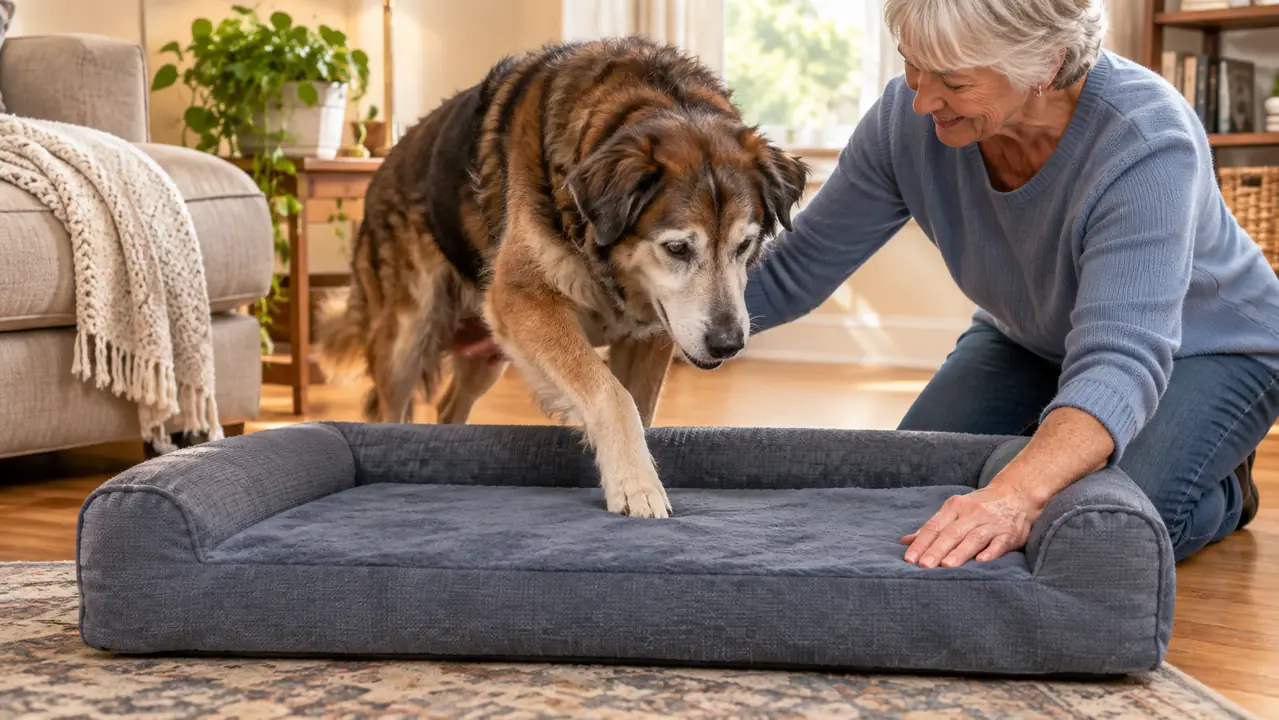
Step 2: Fix the floor under the bed before the bed arrives
The first week, the bed skated. Juni plants her front feet and pushes to stand, and on bare laminate the whole thing slid six inches toward the bookcase. She would finish standing with her back feet on the floor and her front feet still on the bed, which is not what you want from a dog who is already unsteady.
My fix was a rubber backed utility mat under the bed, cut a few inches wider than the bed on every side. Nothing special, the kind of thing sold for entryways. That stopped the sliding completely and it has not moved since. If you have carpet, skip this step. If you have hard flooring and a dog who pushes up rather than rising smoothly, do not skip it.
The other half of this step is the dog's own feet. Juni's back legs slid out from under her on the kitchen floor in September 2025, which is the morning that started all of this. The first thing Dr. Lindqvist's office suggested I look at was traction. I ended up with a set of non-slip socks in November 2025 and she wears them from breakfast to bedtime, indoors only, never on walks. She lifted her feet high around the kitchen for about ten minutes that first morning, and by the third day she ignored them. Her back legs have not gone out on the kitchen floor the way they did that September, and that is what I have seen, not a promise about what will happen with your dog.
Step 3: Match the bed to how your dog actually lies down
The old pillow bed was about an inch of flat fill. Juni lies on her side with her head lower than her shoulders and her chin pushed against something. On the flat bed there was nothing to push against, so her chin hung off the edge and her front legs slid forward until she was half on the floor. That is what all the circling was about.
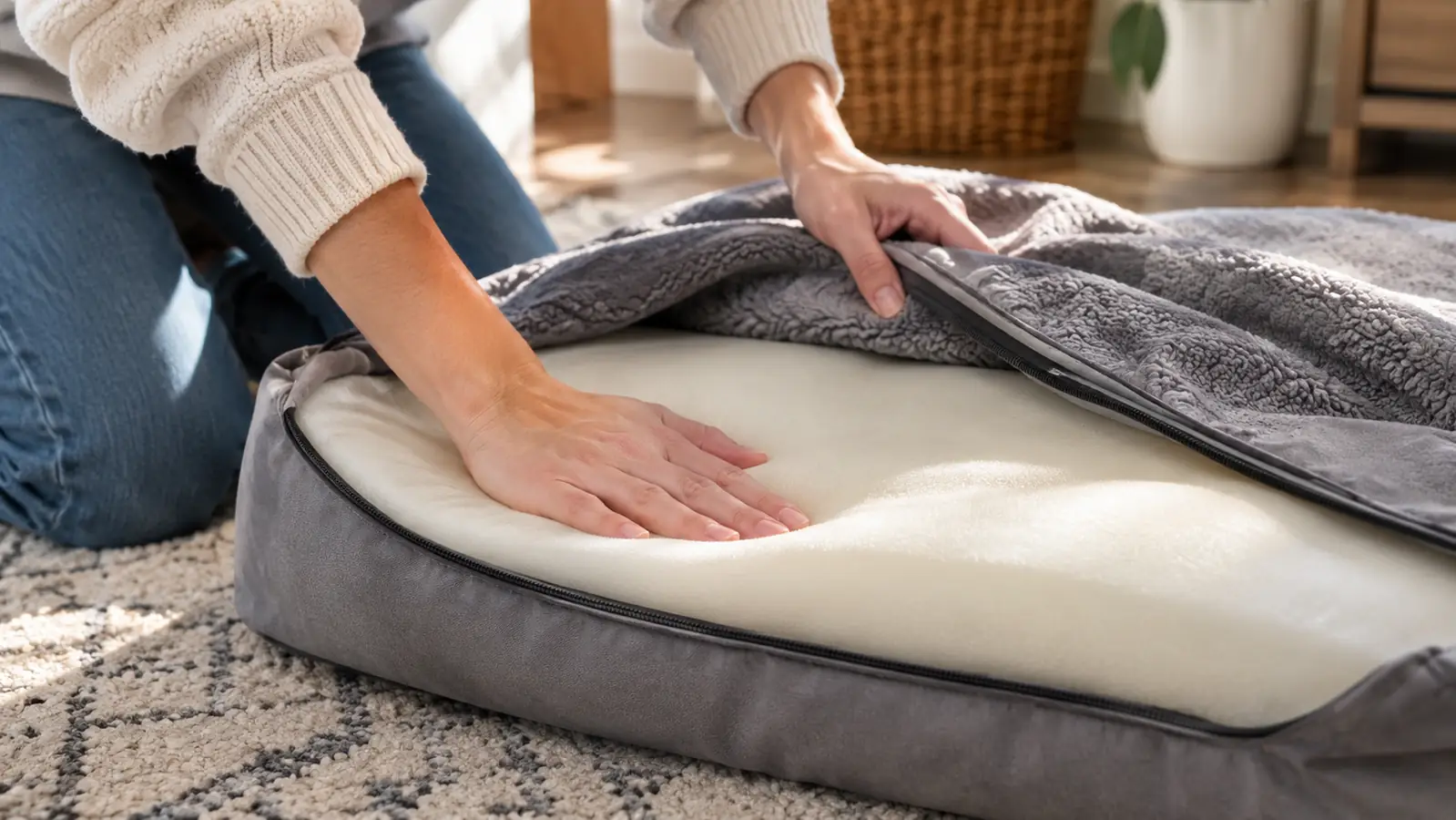
The Bedsure bed is rectangular with a bolster on all four sides, egg-crate polyurethane foam inside, and a cover that zips off and washes. The listing describes the cover as waterproof and the materials as OEKO-TEX certified, and lists the foam as CertiPUR-US certified. The size on my order is 38 by 28 by 6.5 inches, about 6.77 pounds. Juni is 58 pounds and she fits with room to spare, chin up on the bolster, which is the whole reason it worked for her.
Here is the part to read twice, because I nearly sent mine back. The listing shows a maximum weight recommendation of 15 pounds, even though the same listing sells it as a large dog bed and lists the breed recommendation as large. I do not know why those two numbers sit next to each other and I am not going to guess. Juni has slept on it for ten months at 58 pounds and the foam holds her. But read the size chart and the weight line on the listing yourself, with your own dog's number in front of you, and if the two do not line up, ask before you order.
Step 4: Give it a week, and watch the getting up instead of the sleeping
The first night Juni circled twice and lay down. The second night she walked to it on her own before I did. That was the whole of the adjustment for her, and I have heard from enough people with older dogs to know that not every dog takes to a new bed that fast. Some need a worn t-shirt in it first. Give it a week before you decide anything about it.
What I actually watched was not how long she slept. It was the stand up afterward. How many tries it took, whether she pushed off with both back legs or only one, whether she needed a second run at it. I wrote one word a day on the kitchen calendar, because at the end of a month I cannot remember a Tuesday.
I need to be honest about the size of this. The bed did not fix anything and I never expected it to. Juni is still an old dog who is slower than she was a year ago, cold mornings are still her worst, and she still takes the two back steps one at a time. What changed is that she stopped sliding off a thin pillow at two in the morning and having to resettle herself. That is a smaller thing than a cure, and it is a real thing to get out of the way.
What I watched was not how long she slept. It was how many tries it took her to stand up afterward.
Step 5: Wash the cover on a schedule and check the foam once a month
The Bedsure cover unzips and goes in the machine. I do it about every two weeks, more in mud season. The waterproof layer the listing describes means the water bowl spills and the accidents wipe up instead of soaking in, but it does not mean the cover stays clean, so it still gets washed.
The foam is the part nobody tells you to look at. Ten months in, mine has a shallow dip where Juni's hips sit. Egg-crate foam compresses, that is what foam does, and a dog who weighs what she weighs will make a hollow in it. Once a month I press the flat of my hand across the surface and feel for it. I rotate the bed end to end when the dip starts lining up with the same spot every night.
When the dip gets deep enough that she is lying in the hollow of it rather than on top of it, that is when I replace the foam or the whole bed. I am not there yet at ten months. I think I am close.
What Else Helps
The Bedsure bed is one piece of a week. These are the other things in the house that made the sleeping spot work, roughly in the order I added them. Every one of them came after a conversation with Dr. Lindqvist, and none of it is treatment for anything. It is furniture, equipment and a couple of habits.
The harness is a padded rear support sling, a band that goes under the belly and hips with two handles on an adjustable strap. It hangs on a hook by the back door and I use it on the two concrete steps every morning and every evening, taking some of her weight while she does the walking herself. I bought it in March 2026. On bad days I also use it to steady her at the car. What it does not do is anything for her front end, and I have to bend to use it, which at sixty four is its own project.
The ramp is for the Outback and nothing else. It is a PetSafe folding ramp, 62 inches long, 16 inches wide, about 10 pounds, with a high traction tread and four rubber feet. It rides folded in the cargo area. It took about two weeks of practice, first flat on the driveway and then up on the hatch, a bite of string cheese at a time, before she walked it on her own. She uses it about twice a week, the Sunday lake trip and errands. Ten pounds is awkward for me to swing out of the car and it feels steep at the hatch, so I set it and then leave it set.
Two small things. A night light in the hallway, because she gets up once in the night and I would rather she could see where she is going. And a water bowl within a few steps of the bed, so she is not crossing the kitchen on a laminate floor in the dark for a drink. Neither one costs much of anything and both changed how the nights went.
And the thing I would put above all of it: ask your vet what your dog's weight should be and whether there is anything else you should be doing besides rearranging furniture. I am not the person to tell you that, and neither is a product listing. I am one woman with one old dog and a floor that shows every scratch.
Start with the spot. Then the bed.
The one Juni sleeps on is 38 by 28 by 6.5 inches, rectangular, with a bolster on four sides and a cover that comes off for the wash. Read the size chart against your own dog before you order.
Amazon Check Today's Price on Amazon →