
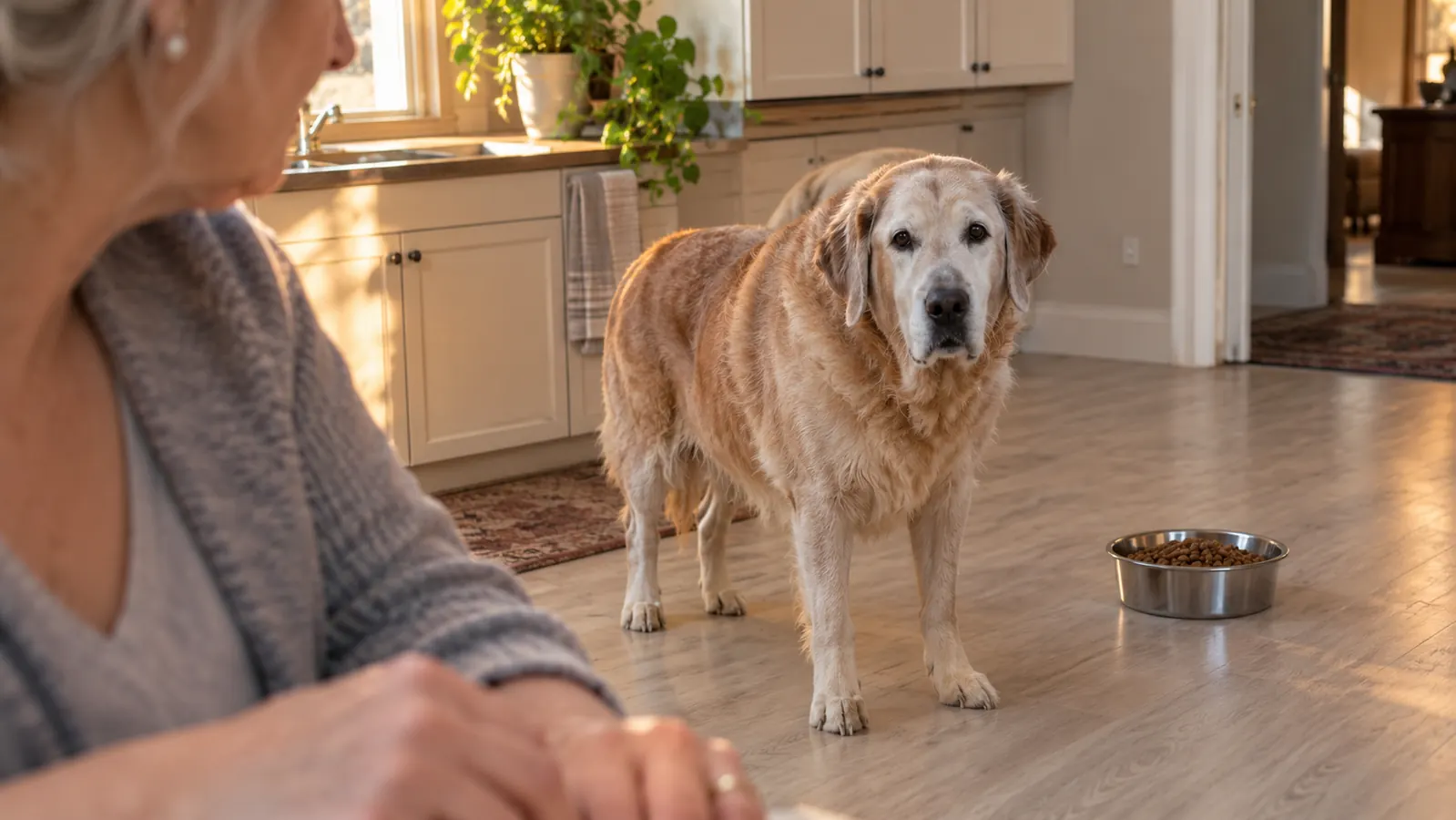
The morning I finally paid attention, my dog's back legs slid out from under her on the kitchen floor. She got up. She always gets up. That was the part that bothered me more than the slip, honestly. Juni is a twelve-year-old Australian Shepherd mix, fifty-eight pounds, and she has spent eleven of those years trotting that hallway like she owns it. That September she went down on the laminate, and the same week she stood at the back of my Outback and would not jump in. I am not a veterinarian and I am not going to write like one. I am a sixty-four-year-old retired library clerk in Coeur d'Alene with one old dog and a hard floor, and this is the routine I built after that week.
Start with your vet. I did, and I will get to that first step in a minute. But the practical part, the part nobody hands you, is how to actually run a supplement routine once you have the go-ahead. The tablets I landed on are Cosequin chewable tablets from Nutramax Laboratories, and Juni has been on them since that September, one serving a day with breakfast, the amount printed on the label for her weight. Before that she had no supplement at all. What follows is the order I did things in, including the month I saw nothing and the four other things I bought before the whole routine held together.
The First Thing I Changed Was the Only Thing That Went in Her Mouth
Cosequin chewable tablets from Nutramax Laboratories, 132 count, one serving daily with breakfast. Call your vet before the first one, especially if your dog is on medication or has a diagnosed condition.
Amazon Check Today's Price on Amazon →Step 1: Ask Your Vet Before You Buy Anything
I called our clinic and got Juni in to see Dr. Lindqvist. I did not walk in with a shopping list. I walked in with the two things I had actually seen with my own eyes: her back legs sliding out on the laminate, and her refusing to jump into the back of the car. He examined her, and he used the word stiff, and he used the word older, and he did not hand me a quick fix. He said a joint supplement was a reasonable thing to try, and then he told me what to watch for so that I would know whether it was worth continuing.
What I would tell you is to bring the whole picture. Every pill, every chew, every powder you already own, including the ones you bought and quietly stopped using. Bring whether your dog is on any medication and whether there is a diagnosed condition in the picture at all, because that changes the conversation. That appointment is the one that decides whether a supplement is worth trying for your dog, and no article on the internet, this one included, can have that conversation for you.
One more thing about this step, and I learned it the hard way by wanting to do everything at once. Start with one thing. Dr. Lindqvist and I talked about one product, I went home with one product, and I did not add anything else to Juni's day for two months. If you change three things in a week and your dog has a good week, you have no idea which one to thank, and no idea which one is worth keeping.
Step 2: Learn the Three Names on the Label
I read the Cosequin label four times before I opened the tub, because that is who I am and because I have been sold things before. The active ingredients listed are glucosamine hydrochloride, sodium chondroitin sulfate, and MSM. Those are the three names I can now say without looking. I am not going to tell you what they do inside your dog's body. I do not know, and I am not qualified to guess. I can tell you they are what is in the product, and that is the level of claim I am willing to make in print.
The reason this step matters is that knowing your three names is how you avoid buying the same thing twice. A shelf full of chews and powders is built around a small handful of ingredients, and two tubs with very different names on the front can be close to the same list on the back. When you know what you are looking for, you can compare two labels honestly. When you do not, you are shopping by the photograph on the tub, which is exactly how these brands would prefer it.
The serving is on the label, by weight, and it is not my number to give you for your dog. Juni is fifty-eight pounds and she gets the amount printed for her weight, once a day. The tub is 132 chewable tablets, and at a bigger dog's serving it goes faster than you expect, so I count what is left before I order rather than discovering on a Sunday morning that we are out.
Step 3: Anchor It to a Meal
For the first two weeks I gave it whenever I remembered, which meant sometime between eight and eleven in the morning depending on the day. That is not a routine. That is a mood. Then I moved it to breakfast, before her kibble goes down in the bowl, and it stopped being something I had to remember at all.
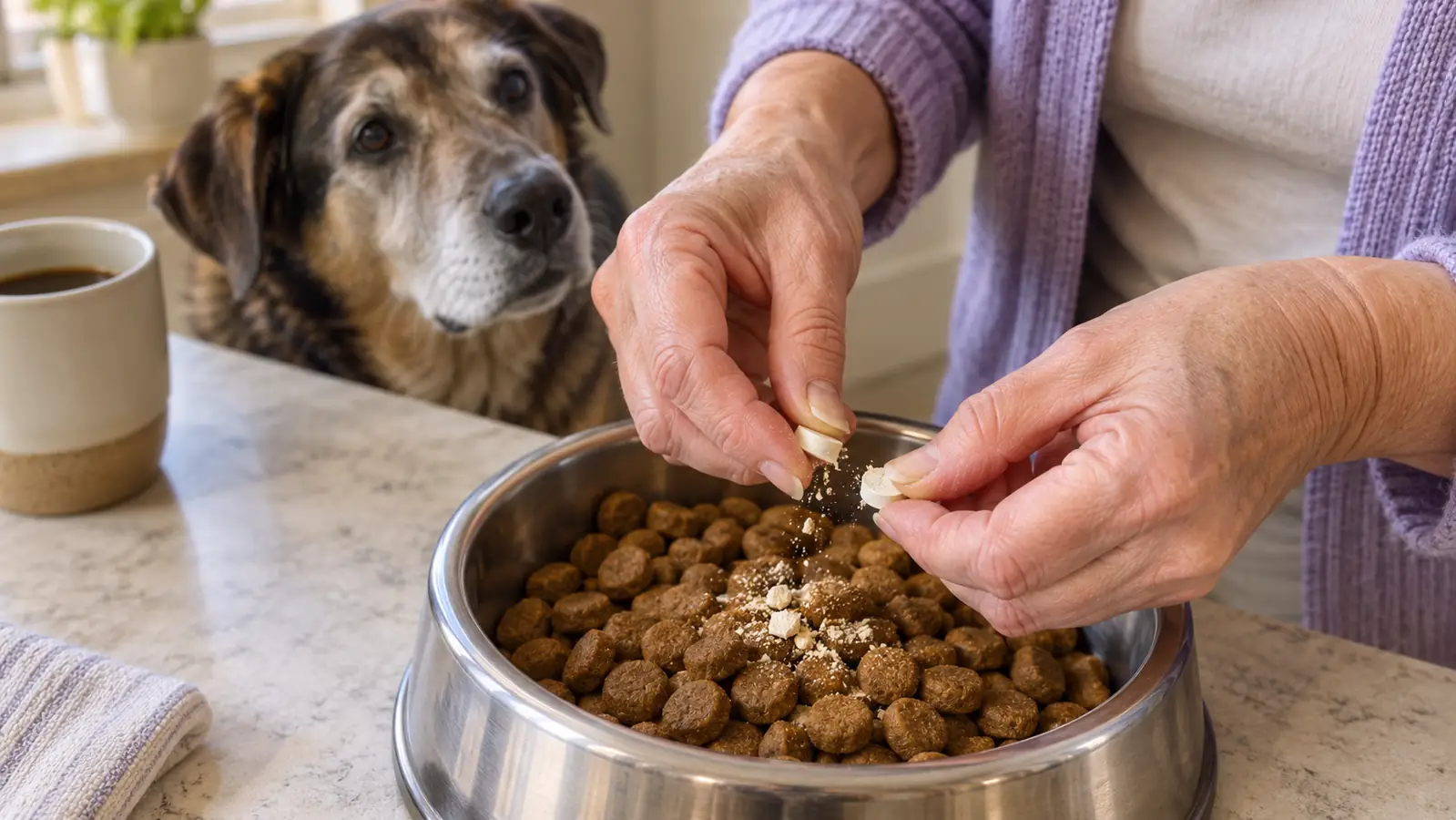
Juni's breakfast is identical every single day. The tablet gets crumbled over the kibble with my thumb, because it is a plain, crumbly tablet and she will pick around a whole one and leave it sitting there like an insult. She eats. I put a mark on the calendar on the fridge. That is the entire system, and the plainness of it is the point. A routine you have to be clever to keep is a routine that dies inside a month.
The anchor matters for a second reason too. Your dog cannot tell you how she feels, so you are going to spend months reading her, and you need a clean read. Same food, same time, same walk, one new thing in the day. Then when something changes you are not sitting at the kitchen table wondering whether it was the tablets or the bag of kibble you switched in the same week.

Step 4: Give It Weeks and Write Down What You See
I wanted it to work in four days. It did not. For the first month I saw nothing I could point to, and I had an entire speech ready about how I had wasted my money on a tub of tablets. Around six weeks in, I noticed Juni getting up off the living room floor a little easier. Not springing. Not a different dog. Getting up, on the first try, without that pause where she used to gather herself before pushing off.
I cannot swear to you that it was the tablets. That is the honest version and I am not going to dress it up for a nicer sentence. Six weeks is also six weeks of shorter walks, of me helping her down the two back steps, of me paying attention instead of assuming. What I can tell you is what I saw and roughly when I saw it, and that is all any owner can actually report.
So write it down. Not a diary and not a spreadsheet. One line a week on the same calendar. How she got up off the floor. Whether she took the two concrete steps down to the yard or stood at the top of them thinking about it. Whether she made it to the end of the block or asked to turn around. Three lines, once a week, and after two months you will have something your vet can actually use, which is worth more than your memory of how she seemed back in March.
I cannot swear it was the tablets. What I can tell you is what I saw, and when I saw it.
Step 5: Fix the Floor, the Steps, and the Car
Here is the part that took me longer than it should have. The supplement was the only thing going into her mouth, but it was never going to be the only thing in her day. Juni was still sliding on the laminate every morning. She was still hesitating at the two concrete steps down to the fenced yard. She was still standing at the back of the Outback with her feet planted, like the hatch was a wall.
Over the next eight months I bought four more things, one at a time, each after asking Dr. Lindqvist. Socks for the laminate, indoors only, never on a walk, because her back legs have not gone out on that kitchen floor the way they did in September and I want to keep it that way. A padded rear sling harness for the two back steps, every morning and every evening, taking some of the weight off her back end while she does the walking. A folding ramp for the car, which took about two weeks of practice flat on the driveway and a great deal of string cheese before she would walk it on her own. And a better bed, because the thin flat pillow she had been sleeping on was not doing her any favors at fifty-eight pounds.
None of those are supplements and I am not going to pretend they are. But a dog who slips on her own floor every morning is a dog whose routine is working against her, and no tablet fixes a hallway. Look at the floor, the steps, and the car. The supplement goes in the bowl. The house is the other half of it.
What Else Helps
Weight, first. Ask your vet what your dog's body condition actually is and be ready for an answer you do not love, because carrying extra pounds on an old frame is work every time she stands up. I am not giving you a number for your dog. I will tell you that Dr. Lindqvist and I talked about Juni's weight in the same appointment where we talked about the supplement, and it was the same conversation, not a separate one.
Then the boring part, which is steady, short and flat. Juni gets about twenty minutes in the morning and a shorter one at dinner, and on Sundays we drive to the lake for a slow walk on level ground. Not a hike. Not a long game of fetch on the concrete driveway. Consistency beats intensity when your dog is twelve, and a dog who is sore after a big Saturday is a dog who does not want to go out the door on Monday.
Warmth and rest matter more than I expected too. Cold mornings are Juni's stiffest, and Idaho winters are long, so her bed sits beside my reading chair in the living room and not in a draft by the door. She sleeps on it all night. I think that is worth about as much as anything I put in her bowl, and I will not pretend I can prove it. Ask your vet what else belongs in the plan for your dog, because there may be things I never needed and you do.
And keep the expectations where they belong. Nothing I did made Juni twelve again. She is still an old dog who is slower than she was two years ago, and the routine is not a reversal, it is a way of not making a hard thing harder. If you are looking for proof that a supplement will change your dog's life, I cannot give it to you. If you want the order I did things in, and the parts I would do again, that is what this is.
Vet First, Then the Bowl, Then the Hallway
Cosequin chewable tablets from Nutramax Laboratories, 132 count. One serving daily, the amount on the label for your dog's weight, crumbled over breakfast. Call your vet before the first one.
Amazon Check Today's Price on Amazon →