
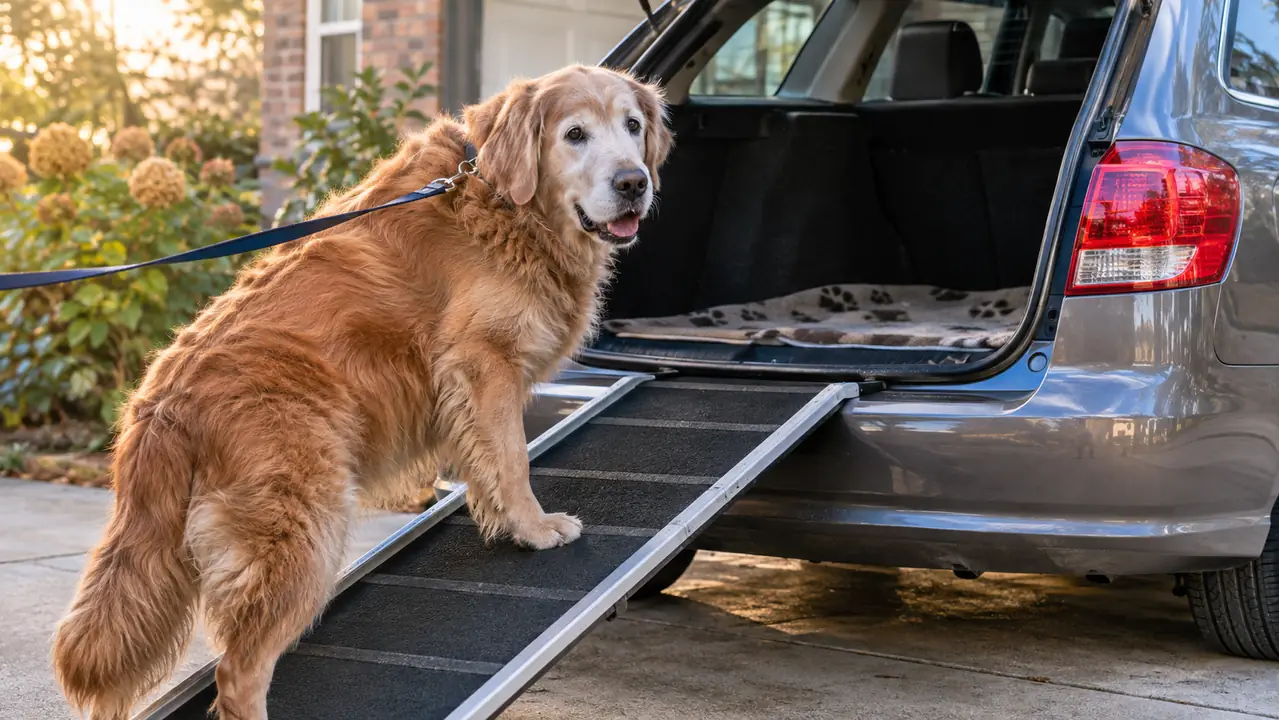
The first time Juni stopped at the back of the Outback, I thought she was being stubborn. She is an Australian Shepherd mix, twelve years old as of April, fifty-eight pounds, and for most of her life she went into that cargo area like she had been fired out of a cannon. That morning in September 2025 she walked up to the bumper, put her front feet on it, and stood there. Then she looked back at me. I stood in the driveway in my slippers for a while, and then I went inside and made coffee and did not think about it, which is what I do when I do not want to think about something.
I could not lift her. Fifty-eight pounds is not a lifting job for a sixty-four-year-old retired library clerk, and my shoulder has opinions. My neighbor Hal helped me get her in twice, once for the vet and once because I had bought forty pounds of potting soil and could not leave her home. That was the whole arrangement, and it was not an arrangement. So I started reading about ramps the way I read about everything, slowly and with a pencil. The PetSafe Happy Ride Folding Dog Ramp went into the Outback in May 2026. It has been there six months, and I am going to tell you what I saw, including the parts I do not love.
The Quick Verdict
A stable, wide folding ramp that solved one specific problem for us: loading a fifty-eight pound dog into the back of a station wagon. It is ten pounds of awkward plastic, and it took two weeks of string cheese before she agreed to it.
Amazon Check Today's Price →She walks into the car on her own now, twice a week
Sixty-two inches long, sixteen inches wide, ten pounds, rated to 150 pounds per the listing. It rides folded in my cargo area and comes out on Sunday mornings and vet days.
Amazon Check Today's Price on Amazon →How I've Used It
Six months, twice a week, and never once for anything except the Outback. That is the whole scope of this review, and I want to be plain about it, because I have read ramp reviews written by people who used one for a weekend at a rental. The ramp stays folded in the cargo area of my 2015 Subaru Outback. Sunday morning we drive to the lake and walk on flat ground. Once or twice a month we go to the vet, or I take her on an errand where she can wait in the car with the hatch up. That is it. I bought this myself, PetSafe has no idea who I am, and nobody asked me to write this.
Training took about two weeks and it was not fun. I started with the ramp flat on the driveway, unfolded on the concrete, and I put string cheese at the bottom and then at the top. Juni will do most things for string cheese. After four or five days of that I set it up on the hatch at the real height, and she walked halfway up and came back down. Twice. Then she walked all the way up on her own, and I have not had to coax her since. She is not a bold dog. If she will do it, most dogs will.
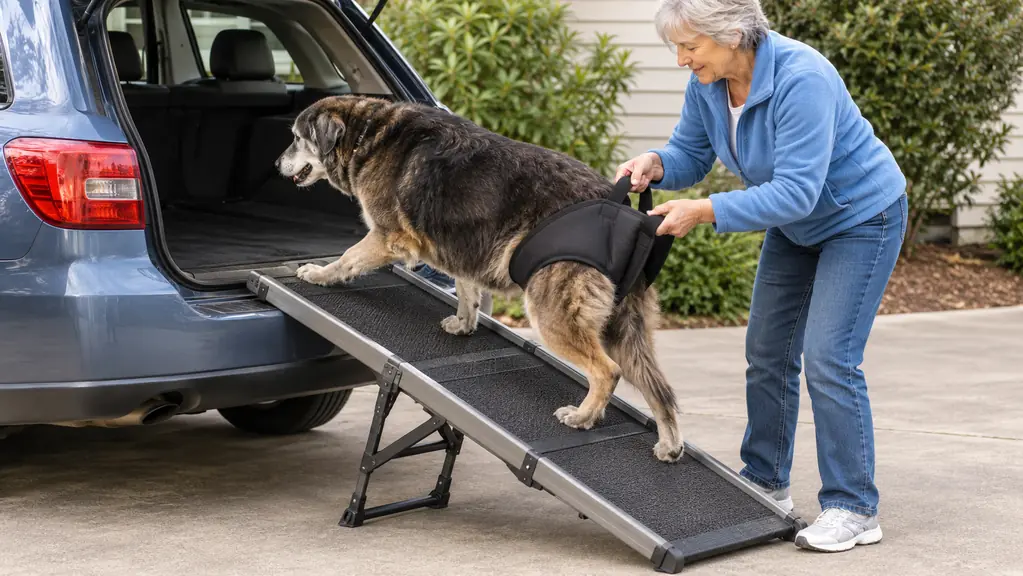
The first dozen times I stood on the uphill side with my hand flat on the ramp so it could not shift, and I kept her rear support harness on her so I could steady her back end if she wobbled. I still do the harness on bad days. I have not lifted her into that car once since the ramp came home, and I want to be honest that this is the single thing the ramp changed. It did not make her younger. She is still slower than she was two years ago and she will stay that way. It got her in and out of the car without either of us dreading it, and around here that is worth something.
What the Listing Says, and What That Means at the Curb
Here is what the PetSafe listing says, because I read it twice before I bought anything. Sixty-two inches long, sixteen inches wide, four inches tall folded. Ten pounds. Plastic. A bi-fold design with a safety release latch, high-traction treads, side rails, and four rubber feet. Load capacity of one hundred fifty pounds. Made in the United States. The listing also contradicts itself on the warranty, with one line saying one thing and the included components line saying another, so I did not buy it for the paperwork and I would suggest you do not either.
The sixty-two inch length is the number that mattered to me and the one I would tell you to measure against your own vehicle. My hatch opening is not level with the ground, and the ramp needs room to sit at an angle. Sixteen inches wide is generous for a fifty-eight pound dog. She has space to drift a little on the way up, and she does drift. If your dog is much wider than mine, or if your vehicle sits higher than an Outback, do your own measuring along the actual line the ramp will take.
The tread is the part I checked with my hand before I let her near it. It is a textured surface and not a smooth plastic panel, and my fingers catch on it. That was the deciding factor for me. A wet plastic surface in an Idaho winter is a bad idea, and I have wiped this one down with a towel more than once before letting her use it. The side rails are low. They give a nervous dog a sense of an edge but they will not stop a dog who decides to bail sideways. The four rubber feet sit on my driveway and on the concrete at the clinic without walking.
Six Months In: What Has Held Up and What Has Not
Six months of twice a week is roughly fifty uses, give or take, and the ramp looks like it. The tread has taken the wear where her back feet land, about two thirds of the way up, and it is scuffed rather than worn through. The hinge is still tight. The safety release latch still releases the way it did in May, and it has never popped open in the back of the car, which was my main worry when I bought it. The rubber feet are still attached and still doing their job.
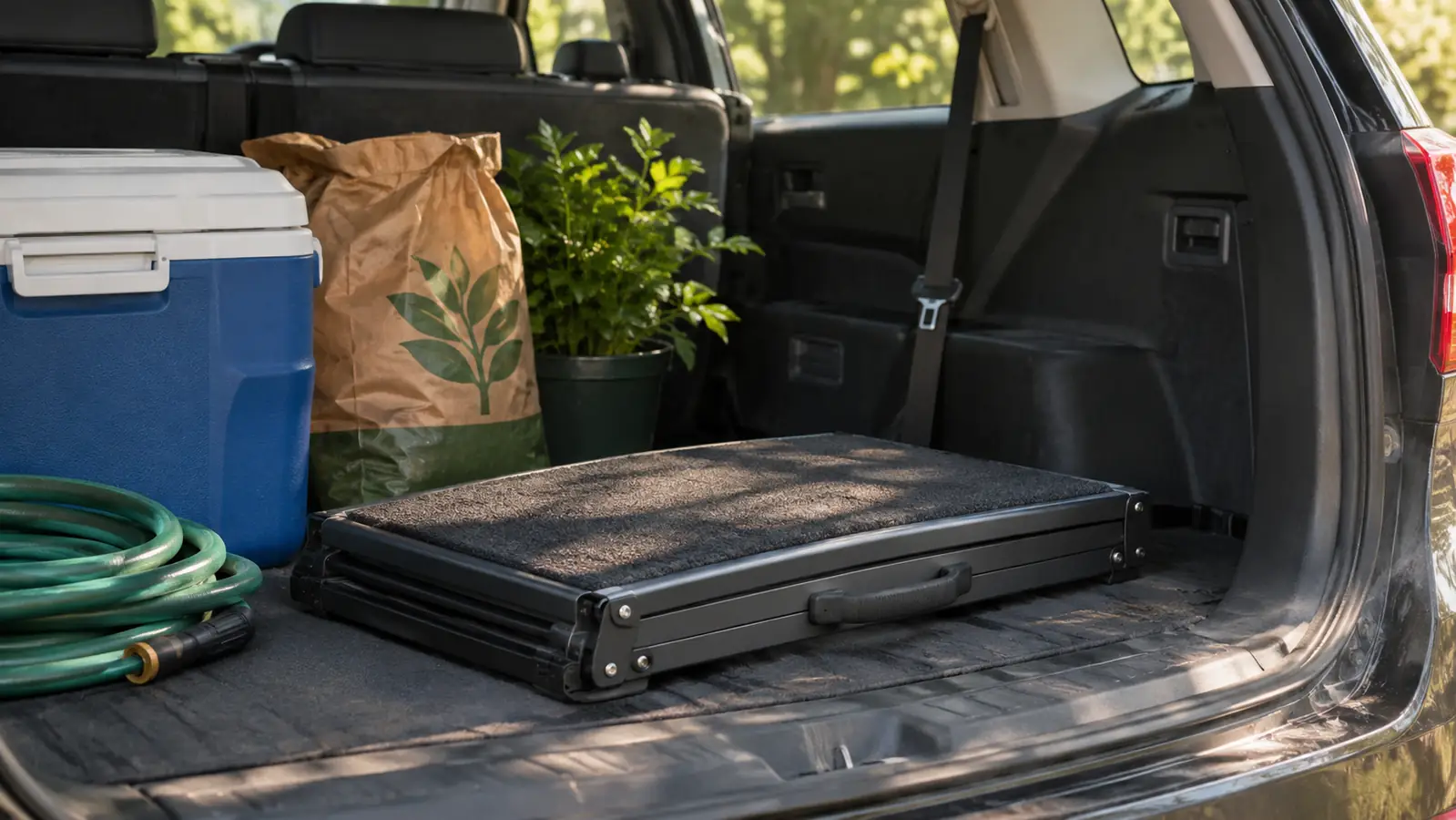
The plastic shows the scuffs you would expect from riding in a cargo area with a cooler and a bag of potting soil. Nothing has cracked. I have not had one moment where the ramp shifted under her weight while she was on it, and I have been watching for one. If it had, you would be reading a different piece.
What has not held up is my patience with how it feels in my hands. Ten pounds is not heavy and I want to make that clear, because a lot of people will read ten pounds and assume it must be flimsy. It is not. But ten pounds of a sixty-two inch folding object is an awkward ten pounds. You are swinging a long plastic panel out of a hatch with one hand while the other hand holds a leash attached to a dog who is extremely interested in the fact that you are going somewhere. In six months I have gotten better at it. I have not gotten graceful.
The Parts That Are Genuinely Awkward
The angle is the honest complaint. My Outback hatch is high enough that sixty-two inches gives a steeper climb than the flat-on-the-driveway version Juni practiced on. She manages it. A dog with less confidence, or one with a shorter stride, might not. A longer ramp means a gentler angle and a shorter one means a steeper one, and this is what it is. Before you buy, put a tape measure against your vehicle and picture the line.
The second complaint is weather. I do not use it on ice. I do not use it when it is wet without wiping it dry first. That is less a flaw in the product than a fact of an Idaho winter and a plastic surface, and I would rather spend thirty seconds with a towel than watch her feet go out from under her. If you live somewhere with real snow, this matters more than anything else in this review.
Third, and this one is about the ramp's job rather than its quality: it does not help her get up. It is a surface, and she does the work. On a bad morning she is slow on that incline and I stand there with my hand on the harness and let her take her time. If you are looking for something that carries the dog, this is not that. It is a path, not a lift.
Where the Ramp Fits in Her Week Now
Some readers will want to know how this sits alongside everything else I have bought for her, and I will say it plainly without making the ramp into more than it is. The non-slip socks are for the laminate indoors and she never wears them on a walk. The rear support harness is for the two concrete steps at the back porch every morning and evening, and on bad days I keep it on her at the car so I can steady her back end while she walks up the ramp. The ramp is for the Outback and nothing else. Nothing I have bought overlaps with anything else, which is why I still have all of it, and I could not tell you which one is doing the most good. I am not a veterinarian and I am not going to pretend to be one.
I asked Dr. Lindqvist before I bought the ramp, the same as I have asked him before everything else, and I would tell you to do the same, especially if your dog has a diagnosis or takes medication. What I can tell you is what I saw in one dog: she gets in and out of my car without help now, twice a week, and I have not had to call Hal in six months. That is the whole size of the claim. She is still an old dog who is slower than she used to be, and no ramp on the market changes that.
What I Liked
- Sixteen inches wide. My fifty-eight pound dog has room to drift on the way up and does not feel crowded.
- The high-traction tread was the reason I bought it and it has held up over roughly fifty uses.
- The safety release latch has never popped open in the cargo area, which was my biggest worry.
- Four rubber feet keep it planted on my driveway and on the concrete at the clinic.
- Folds flat enough to ride in the back of the Outback between trips, so I am not storing it in the garage.
Where It Falls Short
- Ten pounds of awkward. Not heavy, but long, and getting it out one-handed with a leash in the other takes practice.
- Steeper at the hatch than on flat ground, which matters for a less confident dog.
- I will not use it on ice, and I wipe it dry when it is wet. Plastic and winter are not a combination I trust.
- The side rails are low. They give a dog an edge to feel but they will not stop one who bails sideways.
- The listing contradicts itself on the warranty, so I bought it for the ramp and not for the paperwork.
I have not lifted her into that car since May, and I have not had to call Hal once.
Who This Is For
If you have a dog who has started hesitating at the back of a car, and your vehicle's hatch sits close enough to the ground that a sixty-two inch ramp gives a workable angle, this is worth measuring for. It suits an owner who will spend two weeks on practice and who is not expecting the ramp to do the climbing. It has suited us because the car was the one thing Juni could not solve for herself. The floors, the two back steps, the getting up off her bed in the morning, she manages all of that. The car was the wall. If the car is your wall too, this is the sort of thing that takes the wall down.
Who Should Skip It
If your dog is small enough to lift, you do not need this and it will only be in your way. If your dog is heavy and unsteady on a slope, or panics and tries to jump off the side, a ramp with low side rails is the wrong first tool, and a conversation with your veterinarian is a better use of an afternoon than a purchase. If you drive something much taller than a station wagon, measure before you order, because sixty-two inches at a high hatch is a steep climb. And if what you want is something that takes weight off the back end while the dog walks, that is a support sling, not a ramp. This is a surface. The dog still does the work.
The ten-pound panel that ended the lift at my hatch
Rated to 150 pounds per the listing, with high-traction tread, side rails and four rubber feet. It has been folded in my cargo area for six months and it comes out every Sunday.
Amazon Check Today's Price on Amazon →