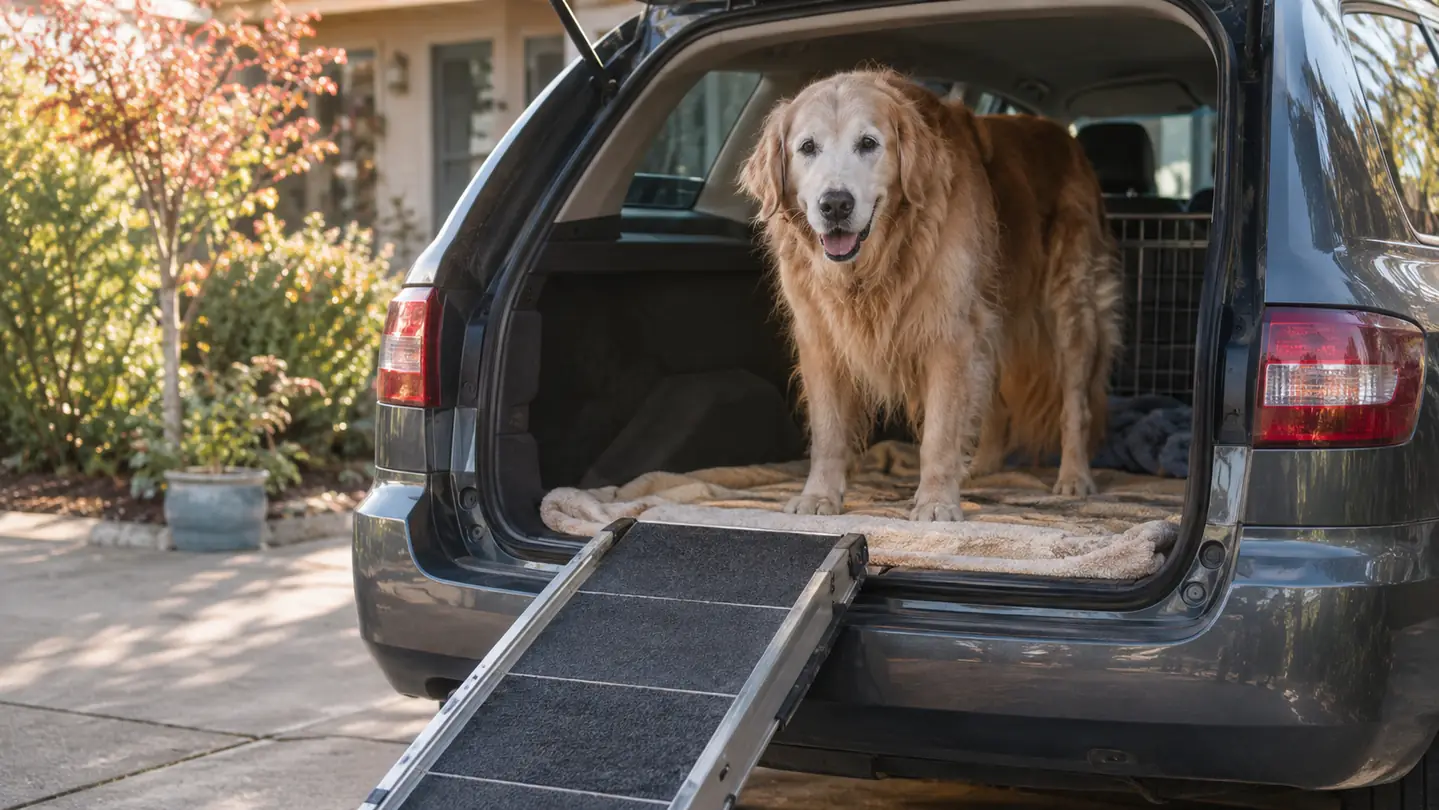
Juni is twelve, fifty-eight pounds, and an Australian Shepherd mix, and for most of her life she jumped into the back of my 2015 Subaru Outback without a second thought. In September 2025 she stopped. She stood at the open hatch, looked at the floor of the car, and did not move. I am sixty-four, I live alone, and I cannot lift a fifty-eight pound dog. For eight months I relied on my neighbor Hal when she had to go to the vet. In May 2026 I bought the PetSafe Happy Ride folding ramp. It did not solve everything, and it took practice, but it is how we get in the car now.
I am not a veterinarian, a vet tech or a trainer. I am a retired county library clerk who reads labels twice and dislikes being sold to. Before I changed Juni's routine I asked Dr. Lindqvist, and I would tell any owner of an older dog to do the same, especially if the dog takes medication or has a diagnosed condition. What follows is what I did with Juni and the PetSafe ramp, in the order I did it, including the parts that were awkward. If your dog is showing something new, do not start with a ramp. Start with your vet.
The ramp that got Juni back into the Outback
The PetSafe Happy Ride folding ramp is 62 inches long, 16 inches wide and 10 pounds, with a 150 pound load capacity per the listing. It folds in the middle and rides in the cargo area. It is the ramp I use with Juni about twice a week.
Amazon See the PetSafe ramp on Amazon →Step 1: Ask your vet first, and be honest about the dog in front of you
Step one is a conversation, not a purchase. I asked Dr. Lindqvist in April 2026 whether Juni could try a ramp, and I described what I was seeing: she was slower getting up, she stood at the hatch, and she did not want to jump. He told me to keep sessions short and to stop if she seemed uncomfortable. He did not name a condition for her, and I am not going to name one here. I am not qualified to do that.
The reason to start with your vet is simple. A ramp is a tool for a dog who can still walk. It is not a substitute for pain control, a diagnosis or a plan for a dog who is getting worse. If your dog yelps, drags a back foot, seems worse after rest, or has a diagnosed condition, ask your vet before you start. The same goes if your dog takes medication. I am not against ramps. I am against skipping the exam.
The other part of step one is measuring your own car and your own dog. I measured the hatch opening on the Outback and the floor of the cargo area. I thought about the approach: my driveway is concrete and mostly level, with a slight slope toward the street. The PetSafe ramp is 62 inches long, so it needs room behind the car. If your parking spot is tight, or the ground is uneven, or the hatch lip is high, a ramp may not be the right answer for you. That is worth knowing before you order one.
Step 2: Unfold the PetSafe ramp on flat ground before you go near the car
I unpacked the PetSafe ramp in the driveway, not at the car. The ramp is plastic, bi-fold, and has a safety release latch, high-traction tread, side rails and four rubber feet. It is 62 inches long, 16 inches wide and 10 pounds, with a 150 pound load capacity per the listing. I opened it flat on the concrete and checked that the latch was seated. I set the four rubber feet on the ground and pushed on the ramp with my hand. I wanted to know how it felt before I asked Juni to trust it.
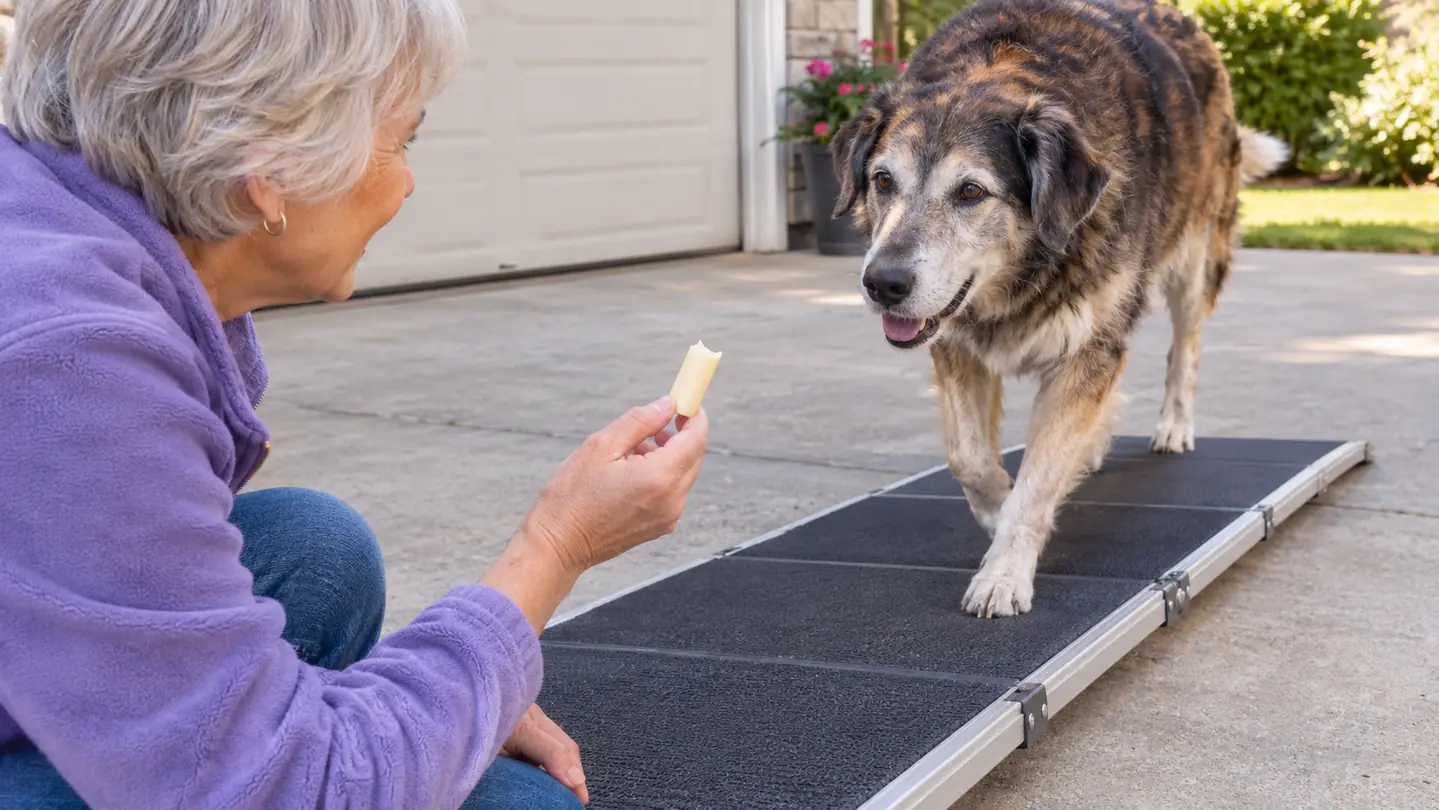
I did not set it at the hatch the first day. I left it flat on the driveway and let Juni sniff it. She walked around it, looked at me, and walked back to the porch. That was fine. I did not call her, pull her or pick her up. I put a piece of string cheese on the ramp and went back to the porch. She came over on her own, took the cheese and left. The first session lasted maybe two minutes. That was the whole lesson.
The flat-ground step matters because the ramp moves a little when a dog steps on it. Not much, but enough for a dog who is already careful. I wanted Juni to feel that movement on the ground before she felt it at the height of the hatch. I also wanted to check the tread with my own hand. If the ramp was wet, I wiped it dry. If the rubber feet were not sitting flat, I moved the ramp. I did that check every time for the first month.
Step 3: Teach the walk on the driveway, one bite at a time
The first week, Juni put one paw on the flat ramp and backed off. I did not push. I put a bite of string cheese near the middle of the ramp and waited. She took one step, then another, then backed off again. I stopped. The next day we did it again. By the third day she walked to the middle for the cheese. By the end of the first week she crossed the whole 62 inches on the flat driveway. It was not graceful. She stopped twice. But she did it.
I kept sessions short, five to ten minutes, and I quit while she was still willing. That was the advice I got from Dr. Lindqvist, and it was the right advice. A dog who is tired or sore is not learning. A dog who is scared is not learning either. If Juni walked away, I let her. I did not use the ramp as a test of obedience. It is a piece of plastic on the ground, and she did not owe it anything.
The second week I started adding the cheese at the far end and then at the hatch, but I kept the ramp flat. I wanted her to walk the length without thinking about height. I also started using the word ramp in the same tone I use for walk. I did not make it a big event. By the end of two weeks she would walk the flat ramp on her own while I stood at the side. That was the point where I felt comfortable putting one end on the car.
The ramp did not teach Juni to use it. Two weeks of string cheese on the driveway did.
Step 4: Set the ramp at the hatch and check the angle and the feet
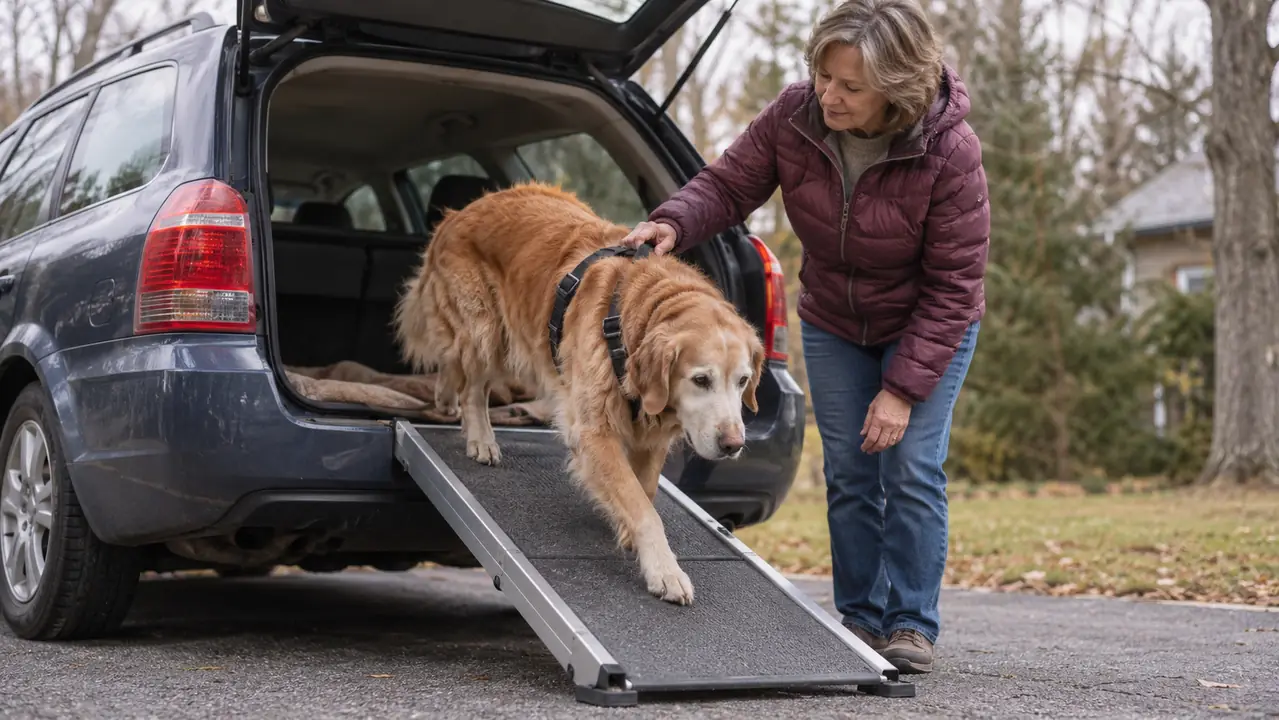
When I put the PetSafe ramp on the Outback, I put the rubber feet on the concrete and the top end on the hatch lip. I checked the safety release latch and the side rails. I made sure the ramp was not resting on the bumper in a way that could slide. The tread was dry. I did not use it on ice, and I do not use it when the ramp is wet without wiping it first. That is not a product failure. That is me being sixty-four and careful.
It felt steep at the hatch. I am not going to pretend it did not. Juni stood at the bottom and looked up at the car. I stood at her side with my hand on the PICK FOR LIFE harness on the bad days, not pulling, just steadying. I put a piece of cheese on the ramp a foot up and let her choose. The first time, she went up two steps and came back down. The second time, she went all the way. It took another week before she did it without a long pause.
The angle is the part I would tell anyone to check on their own car. A 62 inch ramp at the back of a tall hatch is a different walk than a 62 inch ramp at the back of a low car. I do not have a number for the height of my hatch, and I am not going to guess. I can tell you that Juni hesitated more at the top than on the driveway. If your dog is hesitating, do not rush the top. Put the reward lower and let the dog build up to it.
Step 5: Make it a routine, and stop when the dog says stop
We use the ramp about twice a week now. Sunday morning we drive to the lake for a slow walk on flat ground, and we use it for vet visits and errands. The rest of the week it rides folded in the cargo area of the Outback. Ten pounds does not sound like much until you are swinging it out of a hatch in the rain. It is awkward for me. I do it anyway, because the alternative is not lifting her.
I do not lift Juni into the car. At 58 pounds I cannot, and I do not want to try. If she refuses the ramp, I do not force her. I close the hatch, take her back inside, and try again later or call the vet if something seems different. That is the rule. The ramp is not a command. It is a way to get in the car when she is willing. On a bad day, the harness and the ramp together are what we use, and on a good day she walks up with just the ramp.
The ramp is for the Outback and nothing else. The back steps are the harness. The kitchen floor is the socks. The bed is for sleep. I bought each of those one at a time, after asking Dr. Lindqvist, and I cannot prove which one did what. Some weeks I think the ramp is the most important thing I bought. Other weeks I think it is the socks. What I know is that I am not lifting her, and she is getting in the car.
What Else Helps
A ramp is one piece of a larger routine, and I would not want anyone to read this and think a ramp is all they need. I still use the DOK TigerToes socks on the laminate floors indoors, never on walks. I still use the PICK FOR LIFE lift harness on the two back steps every morning and evening, and on bad days at the car while Juni walks up the ramp. Juni still sleeps on the Bedsure bed. She still gets Cosequin once a day with breakfast, crumbled over her kibble, at the serving on the label for her weight. I asked Dr. Lindqvist before I started any of it.
What I noticed with Juni is modest. She seemed to get up a little easier after about six weeks on Cosequin, and I cannot swear it was the tablets. Her back legs have not slid out on the kitchen floor the way they did in September 2025, and I cannot swear it was the socks. The harness takes some weight off her back end on the steps, and I can feel the difference in my own arms. The ramp gets her into the car. None of it has made her young again. She is twelve. She is slower than she used to be. I am telling you what I saw, not what will happen with your dog.
If your dog is done jumping, start with a ramp you can fold and store
The PetSafe Happy Ride folding ramp is the one I use with Juni for the Outback. Check the measurements against your own car, ask your vet about your dog, and give the first week to the driveway.
Amazon Check the PetSafe Happy Ride ramp on Amazon →